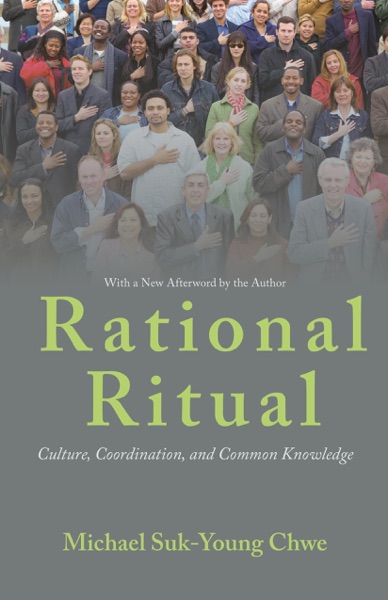
Rational Ritual by Michael Chwe is a 2001 economics book about common knowledge, coordination, ritual and ceremony. Common knowledge — everyone knowing that everyone else knows something — is fundamentally different from mere information, and much harder to create.
Summary
Rational Ritual is a short, elegant book about why certain kinds of social events — rituals, ceremonies, public spectacles, advertising in mass media — serve a function that private communication cannot. Michael Chwe, an economist and political scientist at UCLA, uses game theory to explain why people need not just information but common knowledge: not just knowing something, but knowing that others know it, and knowing that they know that you know it.
The core argument is built around a classic coordination problem. If you want to join a protest, it is not enough to want change and to know that others want change. You need to know that enough other people will also show up that showing up is safe. This requires common knowledge — a shared understanding that everyone has the same information. Private channels create information but not common knowledge. Public events, by putting everyone in the same room or in front of the same broadcast, solve the common knowledge problem that private information cannot.
Chwe applies this framework to an unusually wide range of phenomena: royal ceremonies and coronations, Super Bowl advertising, political rallies, religious rituals, marriage ceremonies, and the structure of the internet. The analysis is consistently surprising without being strained. The Super Bowl chapter is the clearest: it explains why advertisers pay extraordinary premiums for Super Bowl spots that they could reach equivalent numbers with through cheaper alternatives. The point is not reach but simultaneity — everyone watching the same ad at the same time creates common knowledge that cannot be created by scheduling the same ad across many separate broadcasts.
The book is unusually short for an academic work with serious ambitions — about 125 pages plus notes — and it benefits from that compression. Chwe does not overexplain his model or pad the examples. The result is a book that can be read in an afternoon and that changes how you see large public events, advertising, and political mobilization for a long time afterward. Its weaknesses are mostly omissions: the framework handles coordination well but says less about cases where common knowledge is used to suppress rather than enable action. But as an introduction to a genuinely powerful analytical tool, it is hard to beat.
Talk to Rational Ritual like its author wrote you back.
Get the ideas that fit your life — not generic summaries.
- Chat with the book
- Audiobook-style main ideas
- Adapts to your life and goals
- Helps you take action
Key takeaways
- 1.
Common knowledge — everyone knowing that everyone else knows something — is fundamentally different from mere information, and much harder to create.
- 2.
Coordination problems require common knowledge. Showing up to a protest, joining a bank run, or attending a revolution requires not just personal will but the belief that enough others will also act.
- 3.
Public rituals and ceremonies exist partly to create common knowledge that private communication cannot. They put everyone in the same position simultaneously.
- 4.
Super Bowl advertising costs more than equivalent reach elsewhere because the Super Bowl creates common knowledge — everyone knows that everyone is watching — and that simultaneity has economic value.
- 5.
Religious ceremonies, royal coronations, and public inaugurations function as common knowledge generators: they make it clear to everyone that everyone else has accepted a certain order of things.
- 6.
The internet has complicated common knowledge: social media can go viral and reach millions, but it is not always clear who is seeing the same thing at the same time, which limits its coordination-generating power.
- 7.
Political mobilization depends on common knowledge. Authoritarian regimes understand this and suppress public gatherings not primarily because of what is said there but because of what those gatherings produce: the knowledge that everyone else showed up.
Discussion questions
Use these on your own, with a book club, or as chat starters in Superbook. Book club version, ready to copy or print →
- 1.
Chwe argues that Super Bowl ads are priced for common knowledge, not just reach. Does that reframe change how you think about other instances of expensive mass-media advertising?
- 2.
Think of a public ritual in your own life — a wedding, a graduation, a national holiday. What common knowledge was it producing, and what would be lost if it were replaced by private notifications?
- 3.
The book argues that political protests generate common knowledge that private organizing cannot. Does that explain why authoritarian governments restrict public gatherings even when the content seems harmless?
- 4.
How has social media changed the common knowledge problem? Does a viral tweet create common knowledge, or something different?
- 5.
Chwe's framework comes from game theory. Does applying economic reasoning to rituals and ceremonies feel illuminating or reductive to you?
- 6.
The book is short enough to read in an afternoon. Do you find very short, argument-focused academic books more or less convincing than longer ones? What does length signal?
- 7.
What is the common knowledge problem in your own workplace or community? What events or rituals currently solve it, and what gaps remain?
- 8.
Chwe says common knowledge can be used to maintain oppressive orders as well as to coordinate liberation. Can you think of examples where this is true?
- 9.
The argument treats common knowledge as essentially neutral — a tool for coordination that can serve any political end. Is that neutrality convincing?
- 10.
How do you think Zoom meetings and remote work have affected common knowledge in organizations that used to generate it through in-person all-hands or town hall events?
- 11.
If you were designing a new public institution — a policy announcement, a product launch, a community initiative — how would the common knowledge framework change what you would build?
Themes
Frequently asked questions
-
What is common knowledge and why does it matter?
Common knowledge is when everyone knows something, everyone knows that everyone knows it, and so on. It is more than shared information — it is mutual awareness of that sharing. It matters because many social actions (protests, bank runs, agreements) require not just information but the certainty that others are equally informed.
-
Is Rational Ritual an economics book or an anthropology book?
It is primarily a game theory book that uses anthropological and sociological examples. Chwe has formal training as an economist and political scientist; the analysis is rigorous but does not require mathematical background. Anyone comfortable with logical argument will find it accessible.
-
How long is Rational Ritual?
About 125 pages of main text — under three hours at an average reading pace. It is one of the shortest books with real theoretical ambition in social science. You can read it in a single sitting and spend a week thinking about it.
-
Does the Super Bowl advertising example still hold in a streaming era?
Partly. The Super Bowl still generates genuine simultaneity in a way most broadcast events no longer do. Streaming has reduced the common-knowledge premium of most television advertising, which helps explain why advertisers have migrated toward live sports — the last reliably simultaneous broadcasts.
-
Who should read Rational Ritual?
Social scientists, economists, political scientists, and marketers will find it directly useful. It is also rewarding for anyone curious about why large public events feel different from private information — why a concert or a ceremony is not just a broadcast.
Similar books
Thinking, Fast and Slow
Daniel Kahneman
Nudge: Improving Decisions About Health, Wealth, and Happiness
Richard H. Thaler and Cass R. Sunstein
Predictably Irrational
Dan Ariely
Influence: The Psychology of Persuasion
Robert B. Cialdini
