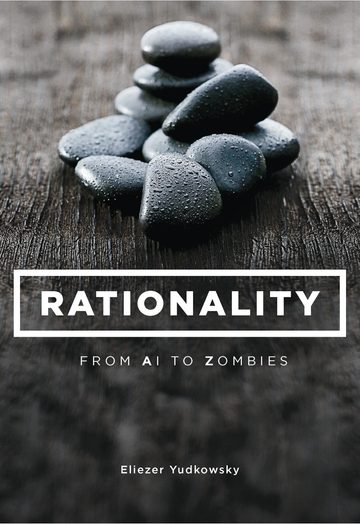
Talk to Rationality: From AI to Zombies like its author wrote you back.
Get the ideas that fit your life — not generic summaries.
- Chat with the book
- Audiobook-style main ideas
- Adapts to your life and goals
- Helps you take action
What it argues
Rationality: From AI to Zombies is a collection of Eliezer Yudkowsky's essays from LessWrong, organized into six books covering the theory and practice of thinking clearly. Yudkowsky's core claim is that human cognition is riddled with systematic biases and cached mental patterns that produce false beliefs, and that most people do not realize how bad their own thinking is. The project of rationality, as he defines it, is to bring your beliefs into alignment with reality (epistemic rationality) and your actions into alignment with your values (instrumental rationality).
The first two books — Map and Territory, and How to Actually Change Your Mind — lay the conceptual groundwork. Yudkowsky draws heavily on Kahneman and Tversky's research on cognitive bias, but pushes further into Bayesian probability theory as the correct normative model of belief updating. He argues that proper reasoning means attaching numerical probabilities to propositions and updating them proportionally when new evidence arrives — most people resist this because it feels mechanical, but the alternative is unexamined intuition that consistently misleads.
What it gets right
- 1.
Epistemic rationality means holding beliefs proportioned to evidence. Instrumental rationality means pursuing your actual goals effectively. The two can come apart, and both require deliberate effort.
- 2.
Cognitive biases are not random errors but systematic distortions built into human cognition. Knowing their names is not enough to overcome them; you need structural changes to your reasoning process.
- 3.
Bayesian probability is the normative framework for updating beliefs. When new evidence arrives, you should update in proportion to how much more likely it makes your hypothesis relative to the alternatives.
What it covers
Who wrote it
Eliezer Yudkowsky is an American AI safety researcher and writer, best known as a co-founder of the Machine Intelligence Research Institute (MIRI) and as the primary author of the LessWrong community blog, where Rationality: From AI to Zombies originated between 2006 and 2009. He has no formal academic credentials but is widely cited in discussions of AI alignment and Bayesian epistemology. He also wrote the popular Harry Potter fan fiction Harry Potter and the Methods of Rationality, which applies many of the same ideas in narrative form.
