Rationality: From AI to Zombies by Eliezer Yudkowsky is a 2015 philosophy book about rationality, cognitive bias, epistemology. Epistemic rationality means holding beliefs proportioned to evidence. Instrumental rationality means pursuing your actual goals effectively. The two can come apart, and both require deliberate effort.
Summary
Rationality: From AI to Zombies is a collection of Eliezer Yudkowsky's essays from LessWrong, organized into six books covering the theory and practice of thinking clearly. Yudkowsky's core claim is that human cognition is riddled with systematic biases and cached mental patterns that produce false beliefs, and that most people do not realize how bad their own thinking is. The project of rationality, as he defines it, is to bring your beliefs into alignment with reality (epistemic rationality) and your actions into alignment with your values (instrumental rationality).
The first two books — Map and Territory, and How to Actually Change Your Mind — lay the conceptual groundwork. Yudkowsky draws heavily on Kahneman and Tversky's research on cognitive bias, but pushes further into Bayesian probability theory as the correct normative model of belief updating. He argues that proper reasoning means attaching numerical probabilities to propositions and updating them proportionally when new evidence arrives — most people resist this because it feels mechanical, but the alternative is unexamined intuition that consistently misleads.
The later books — The Machine in the Ghost, Mere Reality, Mere Goodness, and Becoming Stronger — range across philosophy of mind, decision theory, metaethics, and practical strategy for improving one's own cognition. The philosophy of mind sections take on zombies, qualia, and functionalism in a deliberately combative style. The decision theory material introduces concepts like Newcomb's problem and timeless decision theory. The practical sections discuss how to change your mind under social pressure, how to notice when you are rationalizing rather than reasoning, and how to build habits that make honest updating easier.
The book is not for everyone. At nearly 600,000 words it is an enormous commitment, the tone is often combative and sometimes arrogant, and several of the later philosophical tangents appeal primarily to readers already deep in the LessWrong intellectual tradition. But for the reader willing to engage seriously, many of the individual essays are among the clearest explanations of cognitive bias, Bayesian reasoning, and the nature of belief available anywhere. The core insight — that thinking well is a learnable skill requiring explicit technique, not just intelligence — is worth the investment.
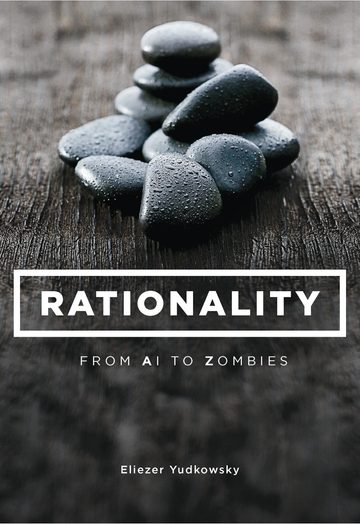
Talk to Rationality: From AI to Zombies like its author wrote you back.
Get the ideas that fit your life — not generic summaries.
- Chat with the book
- Audiobook-style main ideas
- Adapts to your life and goals
- Helps you take action
Key takeaways
- 1.
Epistemic rationality means holding beliefs proportioned to evidence. Instrumental rationality means pursuing your actual goals effectively. The two can come apart, and both require deliberate effort.
- 2.
Cognitive biases are not random errors but systematic distortions built into human cognition. Knowing their names is not enough to overcome them; you need structural changes to your reasoning process.
- 3.
Bayesian probability is the normative framework for updating beliefs. When new evidence arrives, you should update in proportion to how much more likely it makes your hypothesis relative to the alternatives.
- 4.
Rationalizing — starting from a conclusion and finding reasons for it — is far more common than reasoning. Most people do it without noticing. The difference shows in how readily you would abandon the belief if the evidence changed.
- 5.
The map is not the territory. Your mental model of reality is a representation, and representations can be wrong, outdated, or incomplete. Acting as though your map is the territory is the root of most epistemic error.
- 6.
Taboo the word. When a disagreement becomes circular, replace contested terms with specific descriptions of what you actually mean. This often dissolves the argument or reveals that both parties are right about different things.
- 7.
Cached thoughts are mental shortcuts that were once derived but are now applied automatically. Some are useful; many are outdated or adopted uncritically from a social environment. Recognizing them is the first step to revising them.
- 8.
Changing your mind in public is costly in social terms but essential to epistemic integrity. Building a community or environment where updating is celebrated rather than penalized matters as much as individual technique.
Discussion questions
Use these on your own, with a book club, or as chat starters in Superbook. Book club version, ready to copy or print →
- 1.
Yudkowsky argues that holding a belief with 99% confidence rather than certainty is not a weakness but a sign of intellectual honesty. Do you find that comfortable or unsettling, and why?
- 2.
He distinguishes rationalizing from reasoning by whether you would update the belief on contrary evidence. Pick a strong belief you hold — is there any evidence that would cause you to abandon it?
- 3.
The book advocates Bayesian probability as the correct way to reason. What would it mean in your daily life to actually attach numbers to beliefs, and where would that break down?
- 4.
Yudkowsky claims most people's beliefs are heavily shaped by their social environment, not by evidence. Where in your own intellectual life do you see that pattern?
- 5.
The 'map is not the territory' metaphor is central to the book. Where have you most recently been surprised to find that your mental model was wrong in an important way?
- 6.
He argues that intelligence is not enough for good reasoning — that bright people often are just better at rationalizing. Does your experience support that claim?
- 7.
The later books on metaethics argue that moral reasoning is a domain where the same epistemic standards apply. Does that seem right to you, or is ethics different in kind?
- 8.
What is a cached thought — a belief you adopted without examining — that you are aware of holding right now? What would it take to actually re-examine it?
- 9.
Yudkowsky is explicit that this project is motivated partly by concerns about AI safety. Does the AI connection strengthen or weaken the book's appeal to you as a guide to personal reasoning?
- 10.
His tone is often combative and self-assured. How much does authorial voice affect your ability to learn from a book? Did it help or hinder here?
- 11.
The book is nearly 600,000 words. Given what you read, was the length justified? What could have been cut without losing the core argument?
- 12.
He argues that building rationalist communities matters as much as individual practice. What does a community that supports better thinking actually look like?
Themes
Frequently asked questions
-
Is Rationality: From AI to Zombies worth reading?
If you are interested in epistemology, cognitive bias, or decision theory and are willing to read selectively, yes. The best individual essays are excellent. Reading it cover to cover is a major commitment that not everyone will find repays the time investment.
-
How long does it take to read this book?
At average pace, roughly 39 hours — it is nearly 600,000 words, comparable to reading War and Peace. Most readers either read it in sections over months or focus on the first two books, which contain the core epistemological arguments.
-
What is the main argument of this book?
That human reasoning is systematically broken in ways we can identify and partially fix, and that Bayesian probability theory provides the correct normative framework for belief. The project is to make the gap between how we do reason and how we should reason visible and actionable.
-
Who should read this book?
Readers who are already interested in cognitive science or philosophy of mind and want a sustained, opinionated take on how to think better. It is also widely read in technology and AI communities. Readers who prefer more formal academic rigor may find the tone frustrating.
-
What's the most actionable idea in the book?
Tabooing the word: when a debate becomes circular, ban the contested term and force yourself to say what you actually mean. It breaks through verbal disagreements faster than almost any other technique.
Similar books
Thinking, Fast and Slow
Daniel Kahneman
The Enigma of Reason
Hugo Mercier and Dan Sperber
Intuition Pumps and Other Tools for Thinking
Daniel Dennett
The Art of Thinking Clearly
Rolf Dobelli
