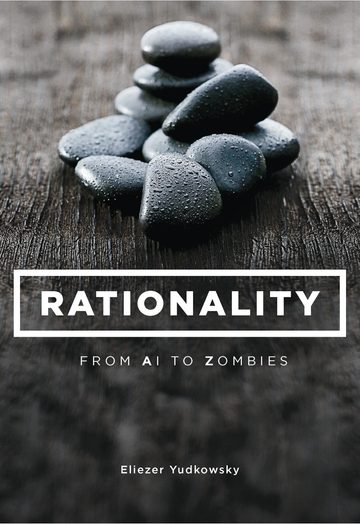
Talk to Rationality: From AI to Zombies like its author wrote you back.
Get the ideas that fit your life — not generic summaries.
- Chat with the book
- Audiobook-style main ideas
- Adapts to your life and goals
- Helps you take action
Rationality: From AI to Zombies, in detail
Rationality: From AI to Zombies is a collection of Eliezer Yudkowsky's essays from LessWrong, organized into six books covering the theory and practice of thinking clearly. Yudkowsky's core claim is that human cognition is riddled with systematic biases and cached mental patterns that produce false beliefs, and that most people do not realize how bad their own thinking is. The project of rationality, as he defines it, is to bring your beliefs into alignment with reality (epistemic rationality) and your actions into alignment with your values (instrumental rationality).
The first two books — Map and Territory, and How to Actually Change Your Mind — lay the conceptual groundwork. Yudkowsky draws heavily on Kahneman and Tversky's research on cognitive bias, but pushes further into Bayesian probability theory as the correct normative model of belief updating. He argues that proper reasoning means attaching numerical probabilities to propositions and updating them proportionally when new evidence arrives — most people resist this because it feels mechanical, but the alternative is unexamined intuition that consistently misleads.
The later books — The Machine in the Ghost, Mere Reality, Mere Goodness, and Becoming Stronger — range across philosophy of mind, decision theory, metaethics, and practical strategy for improving one's own cognition. The philosophy of mind sections take on zombies, qualia, and functionalism in a deliberately combative style. The decision theory material introduces concepts like Newcomb's problem and timeless decision theory. The practical sections discuss how to change your mind under social pressure, how to notice when you are rationalizing rather than reasoning, and how to build habits that make honest updating easier.
The book is not for everyone. At nearly 600,000 words it is an enormous commitment, the tone is often combative and sometimes arrogant, and several of the later philosophical tangents appeal primarily to readers already deep in the LessWrong intellectual tradition. But for the reader willing to engage seriously, many of the individual essays are among the clearest explanations of cognitive bias, Bayesian reasoning, and the nature of belief available anywhere. The core insight — that thinking well is a learnable skill requiring explicit technique, not just intelligence — is worth the investment.
The big ideas
- 1.
Epistemic rationality means holding beliefs proportioned to evidence. Instrumental rationality means pursuing your actual goals effectively. The two can come apart, and both require deliberate effort.
- 2.
Cognitive biases are not random errors but systematic distortions built into human cognition. Knowing their names is not enough to overcome them; you need structural changes to your reasoning process.
- 3.
Bayesian probability is the normative framework for updating beliefs. When new evidence arrives, you should update in proportion to how much more likely it makes your hypothesis relative to the alternatives.
