Talk to Red Notice like its author wrote you back.
Get the ideas that fit your life — not generic summaries.
- Chat with the book
- Audiobook-style main ideas
- Adapts to your life and goals
- Helps you take action
Red Notice, in detail
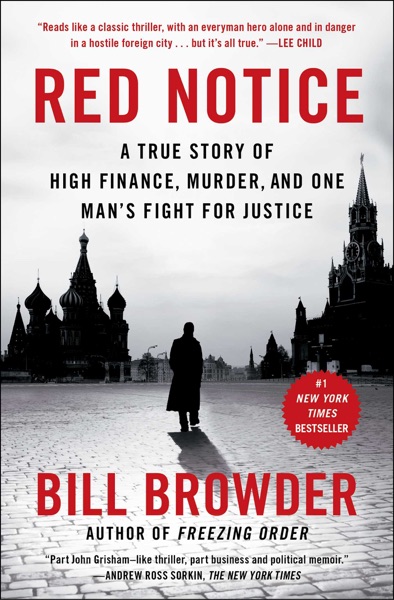
Red Notice is Bill Browder's account of how he became one of the largest foreign investors in Russia after the Soviet collapse, was subsequently expelled by the Kremlin, and then spent years fighting for justice after his lawyer Sergei Magnitsky was arrested, tortured, and killed in a Russian detention facility in 2009. The book is part financial memoir, part political thriller, and part moral reckoning.
Browder's story begins with his early career as a contrarian investor who saw opportunity in post-Soviet Russia while most Western money was skeptical. He describes building Hermitage Capital Management into a significant presence, the mechanics of buying undervalued Russian state assets, and the gradual realization that the privatization era had produced a new class of oligarchs who treated public companies as vehicles for personal enrichment. Browder made money initially by exposing these practices — paradoxically, sunlight raised valuations — but eventually the same oligarchs and their political allies turned on him.
After being expelled from Russia in 2005, Browder hired Magnitsky to investigate fraud involving companies Hermitage had owned. Magnitsky uncovered a complex scheme in which corrupt officials had stolen Hermitage's own corporate registrations and used them to fraudulently reclaim $230 million in taxes the firm had paid. When Magnitsky filed criminal complaints against the officials involved, they had him arrested on fabricated charges. He spent 358 days in pre-trial detention, was denied medical care, and died. The officials he accused were subsequently rewarded.
The final third of the book follows Browder's single-minded campaign to pass the Magnitsky Act in the United States — legislation that allows the U.S. government to sanction foreign human rights abusers and freeze their assets. The act passed in 2012 and has since been adopted in various forms by multiple countries. Red Notice is the story of how personal loss became political purpose, and how one man with resources and determination managed to make the world's most powerful government respond.
The big ideas
- 1.
Russia's privatization era in the 1990s did not produce a market economy in the Western sense. It produced a system in which political connections determined who owned what and for how long.
- 2.
Exposing corruption and accountability can coexist with financial self-interest — Browder profited from transparency, but the underlying goal of transparency was not cynical.
- 3.
The Kremlin's response to Browder's investigation demonstrates how authoritarianism protects itself: the person who uncovers wrongdoing becomes the accused, not the perpetrators.
