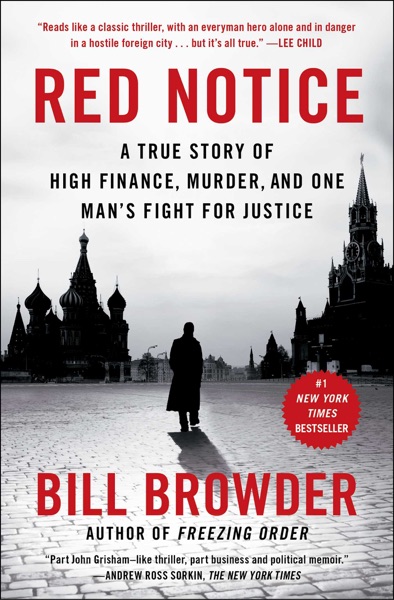
Red Notice by Bill Browder is a 2015 memoir book about corruption, justice, oligarchy. Russia's privatization era in the 1990s did not produce a market economy in the Western sense. It produced a system in which political connections determined who owned what and for how long.
Summary
Red Notice is Bill Browder's account of how he became one of the largest foreign investors in Russia after the Soviet collapse, was subsequently expelled by the Kremlin, and then spent years fighting for justice after his lawyer Sergei Magnitsky was arrested, tortured, and killed in a Russian detention facility in 2009. The book is part financial memoir, part political thriller, and part moral reckoning.
Browder's story begins with his early career as a contrarian investor who saw opportunity in post-Soviet Russia while most Western money was skeptical. He describes building Hermitage Capital Management into a significant presence, the mechanics of buying undervalued Russian state assets, and the gradual realization that the privatization era had produced a new class of oligarchs who treated public companies as vehicles for personal enrichment. Browder made money initially by exposing these practices — paradoxically, sunlight raised valuations — but eventually the same oligarchs and their political allies turned on him.
After being expelled from Russia in 2005, Browder hired Magnitsky to investigate fraud involving companies Hermitage had owned. Magnitsky uncovered a complex scheme in which corrupt officials had stolen Hermitage's own corporate registrations and used them to fraudulently reclaim $230 million in taxes the firm had paid. When Magnitsky filed criminal complaints against the officials involved, they had him arrested on fabricated charges. He spent 358 days in pre-trial detention, was denied medical care, and died. The officials he accused were subsequently rewarded.
The final third of the book follows Browder's single-minded campaign to pass the Magnitsky Act in the United States — legislation that allows the U.S. government to sanction foreign human rights abusers and freeze their assets. The act passed in 2012 and has since been adopted in various forms by multiple countries. Red Notice is the story of how personal loss became political purpose, and how one man with resources and determination managed to make the world's most powerful government respond.
Talk to Red Notice like its author wrote you back.
Get the ideas that fit your life — not generic summaries.
- Chat with the book
- Audiobook-style main ideas
- Adapts to your life and goals
- Helps you take action
Key takeaways
- 1.
Russia's privatization era in the 1990s did not produce a market economy in the Western sense. It produced a system in which political connections determined who owned what and for how long.
- 2.
Exposing corruption and accountability can coexist with financial self-interest — Browder profited from transparency, but the underlying goal of transparency was not cynical.
- 3.
The Kremlin's response to Browder's investigation demonstrates how authoritarianism protects itself: the person who uncovers wrongdoing becomes the accused, not the perpetrators.
- 4.
Sergei Magnitsky's death was not an accident or negligence — the medical records and the sequence of events indicate deliberate denial of care as punishment for his legal work.
- 5.
Targeted financial sanctions — freezing assets and denying travel — turn out to be a more effective tool against kleptocrats than general trade penalties, because kleptocrats have assets abroad that they need to access.
- 6.
The Magnitsky Act was passed over significant opposition from financial institutions and diplomats who prioritized engagement with Russia over accountability. Browder's campaign succeeded against those interests.
- 7.
Personal motivation matters in political campaigns. Browder acknowledges that his obsession with the Magnitsky case was driven by guilt as much as principle — he got Magnitsky into the situation that killed him.
- 8.
Impunity emboldens. When Russian officials responsible for Magnitsky's death faced no consequences, the pattern of behavior continued and expanded in subsequent years.
Discussion questions
Use these on your own, with a book club, or as chat starters in Superbook. Book club version, ready to copy or print →
- 1.
Browder initially saw corruption exposure as a profit opportunity — higher stock prices rewarded honest governance. How do you evaluate a motive that is simultaneously self-interested and socially beneficial?
- 2.
The officials who stole the $230 million were subsequently promoted. What does that pattern suggest about how kleptocratic systems sustain themselves?
- 3.
Browder admits he felt responsible for Magnitsky's death because he hired him and put him in harm's way. How do you think about that kind of indirect responsibility?
- 4.
The Magnitsky Act was initially opposed by financial institutions and State Department officials. What does that tell us about the relationship between economic engagement and human rights in foreign policy?
- 5.
Russia used Interpol's Red Notice system — designed to track criminals — to pursue Browder internationally. What does that tell you about the vulnerability of international institutions to capture by bad actors?
- 6.
Browder's campaign succeeded in part because he was wealthy enough to fund it himself and well-connected enough to get meetings. What does that say about who can and cannot pursue this kind of accountability work?
- 7.
The book is written from a single, strongly partisan perspective. What parts of the narrative would you want to check against other sources?
- 8.
The Kremlin consistently framed Browder as a criminal. How do you evaluate narratives when both sides have strong incentives to lie?
- 9.
By the end of the book, Browder describes himself as having been changed by the campaign — he is less interested in making money and more interested in the work itself. Do you find that transformation credible?
- 10.
The Magnitsky Act has since been used against human rights abusers in countries beyond Russia. Was it a good precedent, and what are the risks of giving any government a unilateral sanctions tool?
- 11.
Corruption at the scale Browder describes depends on lawyers, banks, and accountants in Western countries processing stolen money. What responsibility do those professionals bear?
- 12.
What would you have done in Browder's position after Magnitsky's death? Is the campaign he chose the right one, or are there other approaches that might have been more effective?
Themes
Frequently asked questions
-
Is Red Notice worth reading?
Yes. It reads more like a thriller than a financial memoir and is one of the more propulsive nonfiction books of its decade. The political story it tells is genuinely important and well-evidenced, and Browder's self-awareness about his own motivations gives it more credibility than a purely heroic account would.
-
Is Red Notice one-sided?
It is explicitly written from Browder's perspective and he does not pretend otherwise. The Russian government's account differs significantly. Readers should treat the financial and legal details as Browder's version, though independent reporting on Magnitsky's death has generally corroborated the core facts he presents.
-
What is the Magnitsky Act?
A U.S. law passed in 2012 that allows the government to sanction foreign individuals responsible for human rights abuses or significant corruption by freezing their U.S. assets and revoking their visas. It was named after Sergei Magnitsky and has since been adopted in modified forms by the EU, UK, Canada, and others.
-
Do I need to know about Russia or finance to enjoy Red Notice?
No. Browder explains both the financial context and the political background clearly, and the book works as a narrative even for readers with no prior knowledge of either. The core story is a moral and legal drama that stands on its own.
-
How does Red Notice relate to current Russia policy?
The patterns Browder describes — kleptocracy, impunity, use of legal systems as weapons against critics — have only become more visible since the book was published. Red Notice provides useful historical context for understanding how the Russian state operates and why sanctions-based pressure is the strategy Browder's allies have consistently advocated.
Similar books
Bad Blood: Secrets and Lies in a Silicon Valley Startup
John Carreyrou
Liar's Poker
Michael Lewis
Say Nothing: A True Story of Murder and Memory in Northern Ireland
Patrick Radden Keefe
Black Earth: The Holocaust as History and Warning
Timothy Snyder
