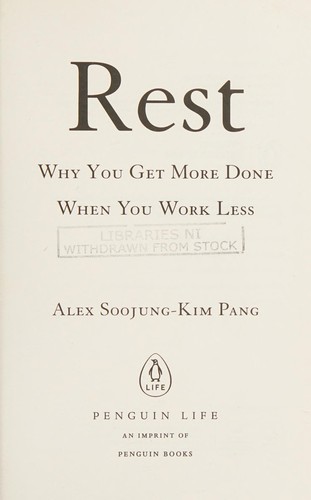
Talk to Rest: Why You Get More Done When You Work Less like its author wrote you back.
Get the ideas that fit your life — not generic summaries.
- Chat with the book
- Audiobook-style main ideas
- Adapts to your life and goals
- Helps you take action
Rest: Why You Get More Done When You Work Less, in detail
Rest makes a case that most of what we think of as productive work is actually counterproductive when pushed past certain thresholds, and that deliberate, well-structured rest is not the opposite of work but a necessary component of it. Pang draws on neuroscience, cognitive science, and biographical research to argue that the world's most productive thinkers and creators — Darwin, Dickens, Einstein, Churchill — worked in shorter, more focused bursts than is commonly assumed and protected their rest with unusual discipline.
The scientific core of the book rests on research into the default mode network, the brain system that activates during apparent idleness. Far from going offline when conscious attention wanders, the default mode network is active during rest, processing recent experiences, generating creative connections, and consolidating learning. Naps, walks, sleep, and deliberate disengagement are not wasted time — they are when much of the actual cognitive work happens, below the surface of awareness.
Pang structures the book around different forms of rest: sleep, naps, walks, hobbies, and sabbaticals. Each chapter surveys research and biographical examples. The material on sleep is the most compelling: chronic sleep deprivation produces measurable declines in creativity, decision quality, and learning that people routinely fail to notice because judgment is one of the first things impaired. The chapter on "deep play" — absorbing hobbies that provide cognitive restoration — argues that serious leisure and serious work reinforce rather than compete with each other.
The book's weakness is length. Some chapters are more thoroughly argued than others, and the biographical examples, while well-chosen, occasionally strain under the weight Pang places on them. But the core argument is sound and the practical implication is clear: if you want to produce more and better work over a career, the question of how you rest deserves as much deliberate attention as the question of how you work.
The big ideas
- 1.
The world's most productive creative minds typically worked four to five hours of deep, focused work per day — not twelve. The rest of their time was structured rest, not idleness.
- 2.
The brain's default mode network is active during apparent rest. Walks, naps, and sleep are when consolidation, pattern recognition, and creative connection often happen.
- 3.
Sleep deprivation erodes performance more severely than people realize, and one of the first casualties is the judgment needed to notice the decline.
