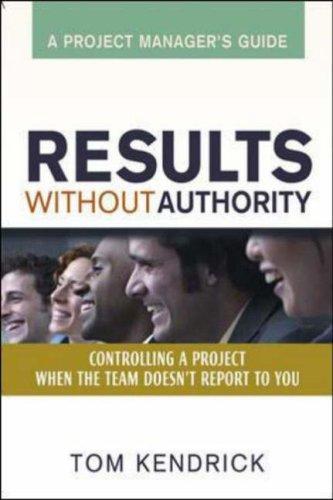
Talk to Results Without Authority like its author wrote you back.
Get the ideas that fit your life — not generic summaries.
- Chat with the book
- Audiobook-style main ideas
- Adapts to your life and goals
- Helps you take action
What it argues
Results Without Authority addresses a challenge that most project managers and team leads face but few management books deal with directly: how to get work done when you have responsibility but no real authority over the people doing the work. Kendrick, who spent years managing large programs at HP, grounds his advice in the practical mechanics of influence rather than leadership theory.
The book's core argument is that authority and control are not the same thing. A project manager who uses positional power aggressively often gets compliance but destroys the collaboration and problem-solving that makes projects actually succeed. The real levers are clarity, relationships, and process. When people understand why something matters, trust the person asking, and have a clear process to follow, they tend to behave reliably without needing to be commanded.
What it gets right
- 1.
Authority and control are distinct. You can get reliable results from people over whom you have no formal power by mastering clarity, relationships, and process.
- 2.
Project charters should be co-created with the team, not handed down. People support what they help build, and shared authorship converts a mandate into a commitment.
- 3.
Involve team members in estimation. People own timelines they've set and resist timelines imposed on them, and bottom-up estimates are usually more accurate anyway.
What it covers
Who wrote it
Tom Kendrick is a project management consultant and trainer with more than two decades of experience leading large-scale technology programs, primarily at Hewlett-Packard. He is also the author of Identifying and Managing Project Risk and 101 Project Management Problems and How to Solve Them. His work focuses on the practical mechanics of project execution in complex organizations — particularly the challenge of managing across functions and geographies without direct authority over the people doing the work.
