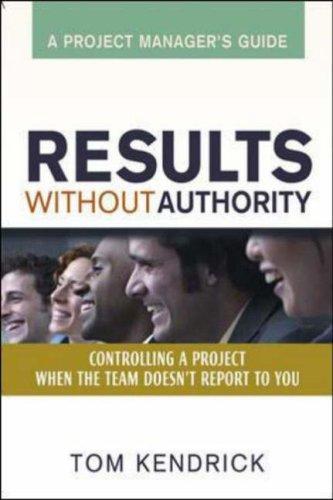
Talk to Results Without Authority like its author wrote you back.
Get the ideas that fit your life — not generic summaries.
- Chat with the book
- Audiobook-style main ideas
- Adapts to your life and goals
- Helps you take action
Results Without Authority, in detail
Results Without Authority addresses a challenge that most project managers and team leads face but few management books deal with directly: how to get work done when you have responsibility but no real authority over the people doing the work. Kendrick, who spent years managing large programs at HP, grounds his advice in the practical mechanics of influence rather than leadership theory.
The book's core argument is that authority and control are not the same thing. A project manager who uses positional power aggressively often gets compliance but destroys the collaboration and problem-solving that makes projects actually succeed. The real levers are clarity, relationships, and process. When people understand why something matters, trust the person asking, and have a clear process to follow, they tend to behave reliably without needing to be commanded.
Kendrick structures the book around the project lifecycle — initiating, planning, executing, and closing — and at each phase identifies the specific influence tactics that work. During initiation, that means framing the project charter in ways that build shared ownership. During planning, it means involving the team in estimation and risk discussion rather than handing down a plan. During execution, the focus shifts to metrics, communication cadence, and recognizing contributions in ways visible to functional managers who control team members' performance reviews.
The writing is methodical and practitioner-focused. Kendrick does not overreach; he doesn't claim influence is equivalent to authority, and he acknowledges that some projects fail because the structural conditions are genuinely broken. The value of the book is the specificity — checklists, templates, and conversation patterns that someone managing their first cross-functional project can use the next day. It reads less like a business bestseller and more like a handbook from an experienced colleague who has made the same mistakes.
The big ideas
- 1.
Authority and control are distinct. You can get reliable results from people over whom you have no formal power by mastering clarity, relationships, and process.
- 2.
Project charters should be co-created with the team, not handed down. People support what they help build, and shared authorship converts a mandate into a commitment.
- 3.
Involve team members in estimation. People own timelines they've set and resist timelines imposed on them, and bottom-up estimates are usually more accurate anyway.
