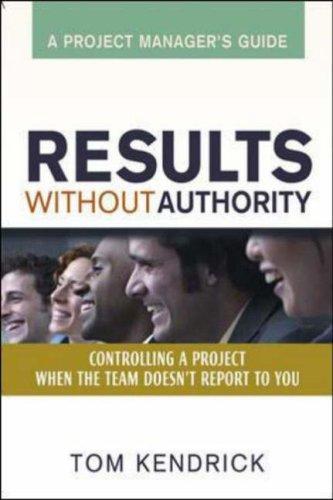
Results Without Authority by Tom Kendrick is a 2006 business book about project management, influence, leadership. Authority and control are distinct. You can get reliable results from people over whom you have no formal power by mastering clarity, relationships, and process.
Summary
Results Without Authority addresses a challenge that most project managers and team leads face but few management books deal with directly: how to get work done when you have responsibility but no real authority over the people doing the work. Kendrick, who spent years managing large programs at HP, grounds his advice in the practical mechanics of influence rather than leadership theory.
The book's core argument is that authority and control are not the same thing. A project manager who uses positional power aggressively often gets compliance but destroys the collaboration and problem-solving that makes projects actually succeed. The real levers are clarity, relationships, and process. When people understand why something matters, trust the person asking, and have a clear process to follow, they tend to behave reliably without needing to be commanded.
Kendrick structures the book around the project lifecycle — initiating, planning, executing, and closing — and at each phase identifies the specific influence tactics that work. During initiation, that means framing the project charter in ways that build shared ownership. During planning, it means involving the team in estimation and risk discussion rather than handing down a plan. During execution, the focus shifts to metrics, communication cadence, and recognizing contributions in ways visible to functional managers who control team members' performance reviews.
The writing is methodical and practitioner-focused. Kendrick does not overreach; he doesn't claim influence is equivalent to authority, and he acknowledges that some projects fail because the structural conditions are genuinely broken. The value of the book is the specificity — checklists, templates, and conversation patterns that someone managing their first cross-functional project can use the next day. It reads less like a business bestseller and more like a handbook from an experienced colleague who has made the same mistakes.
Talk to Results Without Authority like its author wrote you back.
Get the ideas that fit your life — not generic summaries.
- Chat with the book
- Audiobook-style main ideas
- Adapts to your life and goals
- Helps you take action
Key takeaways
- 1.
Authority and control are distinct. You can get reliable results from people over whom you have no formal power by mastering clarity, relationships, and process.
- 2.
Project charters should be co-created with the team, not handed down. People support what they help build, and shared authorship converts a mandate into a commitment.
- 3.
Involve team members in estimation. People own timelines they've set and resist timelines imposed on them, and bottom-up estimates are usually more accurate anyway.
- 4.
Your relationship with each functional manager is as important as your relationship with each team member. The managers control rewards, assignments, and development — use that channel.
- 5.
Metrics and visible tracking change behavior more reliably than pressure. When progress is transparent, people regulate themselves.
- 6.
Communication frequency and predictability build trust faster than charisma. A team that hears from you consistently starts to behave consistently.
- 7.
Recognize contributions publicly and route that recognition to people's functional managers, who control the things team members actually care about.
- 8.
When structural conditions are broken — unclear sponsorship, competing priorities, insufficient resources — the right move is to escalate, not to absorb the problem.
Discussion questions
Use these on your own, with a book club, or as chat starters in Superbook. Book club version, ready to copy or print →
- 1.
Kendrick argues that influence is a more sustainable tool than authority. Have you seen a manager use formal authority in a way that undermined the team's performance?
- 2.
Think of a project you worked on where the team genuinely felt ownership. What conditions created that? Could they be replicated deliberately?
- 3.
What's the difference in your experience between a project charter people contributed to and one that was handed down? Did it affect follow-through?
- 4.
Kendrick emphasizes managing relationships with functional managers, not just team members. How much time do you actually spend on those lateral and upward relationships?
- 5.
When you face competing priorities for a team member's time, what's your current approach? What would a more systematic version look like?
- 6.
Metrics and transparency are presented as tools for self-regulation, not surveillance. Where's the line between those two things in practice?
- 7.
Think of a project that failed or struggled. Was the root cause a technical problem, a structural problem, or an influence failure?
- 8.
Kendrick says some project failures are caused by genuinely broken structures that no amount of influence skill can fix. How do you recognize that point, and what should you do when you reach it?
- 9.
Which of the four project phases — initiation, planning, execution, closing — do you handle least well? What would change if you focused more attention there?
- 10.
How do you currently recognize contributions from team members who don't report to you? Is it visible to the people who control their career progression?
- 11.
Cross-functional teams often have implicit status hierarchies based on function or seniority. How do you counteract those when they undermine collaboration?
- 12.
What's one specific technique from the book you could apply this week to a current project or working relationship?
Themes
Frequently asked questions
-
Who should read Results Without Authority?
Project managers, program managers, team leads, and anyone who regularly coordinates work across teams or functions where they lack direct management control. It's especially useful for people new to matrix organizations or cross-functional programs.
-
Is Results Without Authority still relevant?
Yes. The structural challenge the book addresses — coordinating work across functional silos — is if anything more common now than in 2006, given the prevalence of matrix organizations, distributed teams, and cross-functional squads in technology companies.
-
What is the main idea of Results Without Authority?
That project success depends more on clarity, relationships, and process than on formal authority, and that managers who understand this can build reliable project performance even when they don't control the people doing the work.
-
How practical is the book?
Very. Kendrick includes checklists, template language, and specific conversation patterns. The book is written as a practitioner handbook rather than a theoretical framework, so most readers find something they can use in their current week.
-
How does it compare to other project management books?
Most PM books focus on methodology — agile, waterfall, scope management. This one focuses specifically on the human influence layer that methodology books tend to assume away. It's a complement to technical PM training, not a replacement.