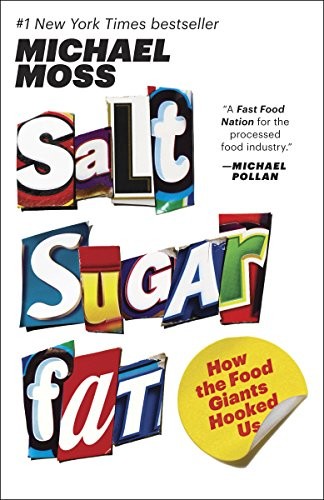
Talk to Salt Sugar Fat like its author wrote you back.
Get the ideas that fit your life — not generic summaries.
- Chat with the book
- Audiobook-style main ideas
- Adapts to your life and goals
- Helps you take action
What it argues
Michael Moss, a Pulitzer Prize-winning investigative journalist, spent four years inside the processed food industry to produce Salt Sugar Fat. His thesis is that the epidemics of obesity, type 2 diabetes, and hypertension in the United States are not primarily the product of consumer choice or individual weakness — they are the engineered result of a decades-long effort by the food industry to optimize products for maximum consumption.
Moss traces how the three ingredients of the title became the primary tools of that optimization. Sugar activates dopamine pathways in a way that makes sweet foods difficult to stop eating. Fat provides texture and carries flavor in ways that amplify every other sensation. Salt both enhances flavor and — at higher concentrations — triggers craving and overrides satiety. The food science concept of the "bliss point" — the precise sugar level that maximizes pleasure without tipping into sweetness fatigue — runs through the book as a symbol of the industry's precision and its willingness to exploit human biology.
What it gets right
- 1.
The processed food industry spent decades engineering products to hit the 'bliss point' — the exact combination of salt, sugar, and fat that drives maximum consumption.
- 2.
Sugar activates the brain's reward pathways in ways that promote habit formation, and food companies used this knowledge deliberately in product development.
- 3.
Salt does more than flavor food: at certain concentrations it creates a craving-and-reward cycle that overrides the body's satiety signals.
What it covers
Who wrote it
Michael Moss is an American investigative journalist who won the Pulitzer Prize in 2010 for his reporting on contaminated meat in the US food supply. He was a staff writer at The New York Times for many years and is the author of two books on the food industry. His follow-up to Salt Sugar Fat, Hooked, published in 2021, examines addiction science and how it has been applied across industries including processed food, social media, and prescription drugs.
