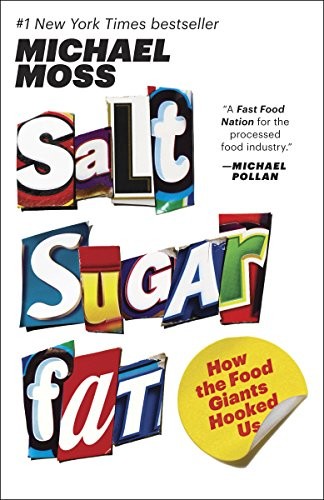
Salt Sugar Fat by Michael Moss is a 2013 science book about food industry, addiction, public health. The processed food industry spent decades engineering products to hit the 'bliss point' — the exact combination of salt, sugar, and fat that drives maximum consumption.
Summary
Michael Moss, a Pulitzer Prize-winning investigative journalist, spent four years inside the processed food industry to produce Salt Sugar Fat. His thesis is that the epidemics of obesity, type 2 diabetes, and hypertension in the United States are not primarily the product of consumer choice or individual weakness — they are the engineered result of a decades-long effort by the food industry to optimize products for maximum consumption.
Moss traces how the three ingredients of the title became the primary tools of that optimization. Sugar activates dopamine pathways in a way that makes sweet foods difficult to stop eating. Fat provides texture and carries flavor in ways that amplify every other sensation. Salt both enhances flavor and — at higher concentrations — triggers craving and overrides satiety. The food science concept of the "bliss point" — the precise sugar level that maximizes pleasure without tipping into sweetness fatigue — runs through the book as a symbol of the industry's precision and its willingness to exploit human biology.
The book profiles the executives, scientists, and marketers who built processed food giants including Kraft, Nestlé, General Mills, and Coca-Cola, and tracks the internal debates many of them had about whether to rein in the salt, sugar, and fat in their products. The short answer is almost uniformly no: competitive pressures, shareholder demands, and the difficulty of reformulating established products without consumers noticing produced a persistent race to the bottom. Internal documents Moss obtained through court cases show that executives knew the health implications of their products while continuing to market them aggressively to children.
Salt Sugar Fat is not a dietary prescription and does not tell readers what to eat instead. It is investigative journalism in the tradition of muckraking — an account of how an industry works, who makes decisions, and who bears the cost. Read as such, it is thorough and often infuriating. The implications for food policy are left largely to the reader to draw.
Talk to Salt Sugar Fat like its author wrote you back.
Get the ideas that fit your life — not generic summaries.
- Chat with the book
- Audiobook-style main ideas
- Adapts to your life and goals
- Helps you take action
Key takeaways
- 1.
The processed food industry spent decades engineering products to hit the 'bliss point' — the exact combination of salt, sugar, and fat that drives maximum consumption.
- 2.
Sugar activates the brain's reward pathways in ways that promote habit formation, and food companies used this knowledge deliberately in product development.
- 3.
Salt does more than flavor food: at certain concentrations it creates a craving-and-reward cycle that overrides the body's satiety signals.
- 4.
Food company executives had access to internal research showing health risks but consistently prioritized market share over reformulation.
- 5.
Processed foods are marketed most heavily to children and low-income communities, concentrating their health effects in the populations least able to navigate them.
- 6.
The individual willpower explanation for obesity ignores the enormous resources the food industry spends specifically to undermine willpower and habituate consumers.
- 7.
Internal food company documents obtained through litigation show explicit discussions of addiction-like properties and deliberate decisions to maintain them.
- 8.
Several senior food company scientists and executives became critics of the industry after leaving — a pattern Moss uses to document what the industry knows internally.
Discussion questions
Use these on your own, with a book club, or as chat starters in Superbook. Book club version, ready to copy or print →
- 1.
Moss argues that individual willpower is essentially overmatched by the engineering behind processed food. Do you find that argument convincing, or does it too easily excuse personal responsibility?
- 2.
The bliss point concept treats human biology as a system to be exploited for profit. What ethical framework would you apply to companies that operate this way?
- 3.
Do you think people's food preferences are genuinely their own, or substantially manufactured by the food industry? How would you even know?
- 4.
The book documents executives who had doubts but continued anyway. What pressures do you think explain that, and how common is that dynamic in other industries?
- 5.
Should food companies that market addictive products to children face the same kind of regulatory response that tobacco companies eventually did?
- 6.
Moss found that many processed food executives ate differently at home from what their companies sold. What does that tell you?
- 7.
Have you ever caught yourself unable to stop eating a specific processed food? What do you think was happening physiologically?
- 8.
Salt Sugar Fat doesn't tell you what to eat instead. Is that the right journalistic approach, or should investigative books about public health take a position?
- 9.
The book was published in 2013. Has the processed food industry changed its practices in the years since, or do you think the incentive structure is essentially the same?
- 10.
Reformulating products to reduce salt, sugar, or fat almost always reduces sales, at least short-term. Is there a plausible mechanism by which the industry could change without regulatory pressure?
- 11.
Which of the three ingredients — salt, sugar, or fat — do you think has the most outsized role in your own eating, and why?
- 12.
How does reading about the food industry change your relationship to specific products you regularly consume?
Themes
Frequently asked questions
-
Is Salt Sugar Fat worth reading?
Yes, particularly for the internal industry documents and executive interviews that aren't available elsewhere. It's less prescriptive than most food books — Moss reports rather than advises — which is both its strength and its limitation.
-
How long is Salt Sugar Fat?
About 450 pages, roughly six to seven hours of reading time. The chapters are organized by ingredient and read fairly quickly despite the density of reporting.
-
What is the bliss point?
A food science term for the precise concentration of sugar in a product that produces maximum enjoyment without triggering sweetness fatigue. Moss uses it as a symbol of the broader project of optimizing food for consumption rather than nutrition.
-
Who should read Salt Sugar Fat?
Anyone interested in how consumer products are developed, in food policy, or in the structural causes of the obesity epidemic. Also recommended for people who find themselves unable to moderate certain processed foods and want to understand why.
-
Does the book say what to eat instead?
No. Salt Sugar Fat is investigative journalism, not a diet book. It documents how the industry works and what executives knew. The dietary implications are left to the reader.