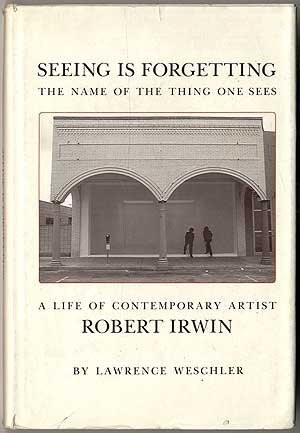
Talk to Seeing Is Forgetting the Name of the Thing One Sees like its author wrote you back.
Get the ideas that fit your life — not generic summaries.
- Chat with the book
- Audiobook-style main ideas
- Adapts to your life and goals
- Helps you take action
What it argues
Seeing Is Forgetting the Name of the Thing One Sees is Lawrence Weschler's extended portrait of Robert Irwin, the California artist who began his career as an abstract expressionist painter and progressively dismantled every element of conventional art-making — frame, canvas, pigment, discrete object — until he was working with pure perception itself. The book was assembled from years of conversations and grew alongside the work it describes, first published in 1982 and expanded in later editions to follow Irwin's career through large-scale installation and garden design.
Weschler traces Irwin's evolution through several distinct phases. The early paintings are tight, gestural, emotionally driven. Then Irwin begins to question the frame, the edge, the relationship between the painted surface and the wall it hangs on. The discs that follow — convex aluminum surfaces lit to dissolve their own edges — are attempts to make an object that disappears into its perceptual context. Finally Irwin abandons objects altogether: his later work is light, scrim, site-specific conditions in which the viewer's own perception is the medium.
What it gets right
- 1.
Irwin's project was to strip art down to the conditions of perception itself — removing every familiar element until the work required genuine, fresh seeing rather than recognition.
- 2.
The title's idea, derived from Valéry, is central: to see something freshly, you have to suspend the name and category you have already applied to it.
- 3.
Irwin's evolution through painting to object to environment is driven by internal logic: each solution creates a new problem about what the frame, the edge, or the object is doing to perception.
What it covers
Who wrote it
Lawrence Weschler is an American journalist and writer who worked for The New Yorker for over twenty years. His books include Shapinsky's Karma, Boggs's Bills and Other True-Life Tales (1988), Mr. Wilson's Cabinet of Wonder (1995), and Vermeer in Bosnia (2004). He taught at New York University and is known for long-form profiles that combine intellectual biography with philosophical reflection. Seeing Is Forgetting the Name of the Thing One Sees, his portrait of Robert Irwin, is widely regarded as one of the best books about an artist at work written in the twentieth century.
