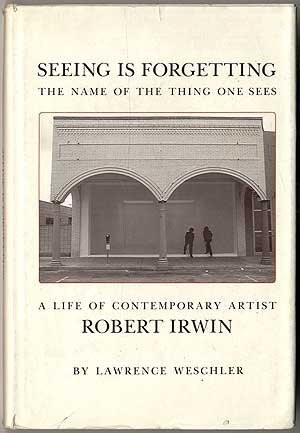
Seeing Is Forgetting the Name of the Thing One Sees by Lawrence Weschler is a 1982 biography book about perception, art practice, conceptual art. Irwin's project was to strip art down to the conditions of perception itself — removing every familiar element until the work required genuine, fresh seeing rather than recognition.
Summary
Seeing Is Forgetting the Name of the Thing One Sees is Lawrence Weschler's extended portrait of Robert Irwin, the California artist who began his career as an abstract expressionist painter and progressively dismantled every element of conventional art-making — frame, canvas, pigment, discrete object — until he was working with pure perception itself. The book was assembled from years of conversations and grew alongside the work it describes, first published in 1982 and expanded in later editions to follow Irwin's career through large-scale installation and garden design.
Weschler traces Irwin's evolution through several distinct phases. The early paintings are tight, gestural, emotionally driven. Then Irwin begins to question the frame, the edge, the relationship between the painted surface and the wall it hangs on. The discs that follow — convex aluminum surfaces lit to dissolve their own edges — are attempts to make an object that disappears into its perceptual context. Finally Irwin abandons objects altogether: his later work is light, scrim, site-specific conditions in which the viewer's own perception is the medium.
The intellectual core of the book is Irwin's phenomenological inquiry into attention. Irwin is not a systematic philosopher, but he has arrived through studio practice at questions about perception that parallel phenomenologists like Merleau-Ponty: what is it to see something rather than to see through it? What happens when you slow down and look at the peripheral, the ambient, the overlooked? The title is a paraphrase of a line from Paul Valéry: the act of seeing freshly requires setting aside the name you have given a thing, which is also the thing you already know about it.
The book is as much a meditation on creative obsession as a biography. Weschler is a careful, admiring interviewer who allows Irwin's thinking to unfold at its own pace. The conversations meander in ways that reflect the exploratory quality of Irwin's practice. For readers interested in the relationship between attention, perception, and creative work — and willing to follow an artist who asks his audience to give up familiar anchors — it is among the more quietly useful books about making things.
Talk to Seeing Is Forgetting the Name of the Thing One Sees like its author wrote you back.
Get the ideas that fit your life — not generic summaries.
- Chat with the book
- Audiobook-style main ideas
- Adapts to your life and goals
- Helps you take action
Key takeaways
- 1.
Irwin's project was to strip art down to the conditions of perception itself — removing every familiar element until the work required genuine, fresh seeing rather than recognition.
- 2.
The title's idea, derived from Valéry, is central: to see something freshly, you have to suspend the name and category you have already applied to it.
- 3.
Irwin's evolution through painting to object to environment is driven by internal logic: each solution creates a new problem about what the frame, the edge, or the object is doing to perception.
- 4.
The scrim and light installations are not minimal in the simple sense — they are maximally demanding of attention, requiring the viewer to slow down and work.
- 5.
Site-specific work, which Irwin championed, treats the existing conditions of a space as active ingredients rather than neutral containers to be filled.
- 6.
Irwin's ideas about perception developed through practice, not philosophy — he arrived at phenomenological territory by being a working artist who refused easy solutions.
- 7.
The conversations in the book show that creative rigor does not require systematic articulation — Irwin's thinking is genuinely exploratory and the book models what that looks like.
Discussion questions
Use these on your own, with a book club, or as chat starters in Superbook. Book club version, ready to copy or print →
- 1.
Irwin progressively eliminated every conventional element of art-making until he reached perception itself. Is there a logic to that progression, or does it look like a sequence of refusals without a destination?
- 2.
The title argues that naming a thing interferes with seeing it. Can you think of contexts in your own experience — professional or personal — where what you already know gets in the way of what you could see?
- 3.
Irwin's late work is often invisible until you are actually standing in it. Is there a distinction between art that rewards sustained attention and art that merely requires it?
- 4.
Weschler's book is as much a portrait of obsessive creative inquiry as a biography. What does it suggest about what a life in art requires, and whether that life is compatible with other things?
- 5.
The dot paintings and the discs are objects that work hard to dissolve their own objecthood. What does Irwin seem to think objects are for in the history of art, and why does he want to escape them?
- 6.
Irwin's evolution was driven partly by the absence of a satisfying answer to his previous work. How does creative dissatisfaction function differently from ordinary dissatisfaction?
- 7.
The book was expanded in later editions as Irwin's work continued. What is gained or lost by a biography that grows alongside its subject rather than looking back from a fixed endpoint?
- 8.
Site-specific installation resists collection and sale in the conventional sense. What does Irwin's commitment to that form say about his relationship to the art market?
- 9.
Weschler is clearly sympathetic to Irwin. Does that sympathy help or limit the portrait? What questions does it seem to skip?
- 10.
The idea of 'seeing is forgetting the name of the thing one sees' applies beyond art. Where in your daily life do you most rely on category and name rather than direct perception?
- 11.
Irwin's work requires institutional support — museums, galleries, site owners — even as it questions the conventions of the institution. How does that tension show up in the book?
Themes
Frequently asked questions
-
Who is Robert Irwin, and why does he matter?
Irwin is a major figure in postwar American art, associated with the California Light and Space movement. His work influenced how artists think about perception, environment, and site-specificity. The Getty Center garden in Los Angeles is among his most visible works.
-
Do I need to know about art to read this book?
No formal art history background is required. The book is more a philosophical conversation about perception and creative process than a critical history. Readers who are curious about how artists think will find it accessible.
-
How long is Seeing Is Forgetting the Name of the Thing One Sees?
About 200 pages in the expanded edition, roughly three to four hours to read. The book moves at a reflective pace that matches its subject.
-
What does the title mean?
It paraphrases a line from the French poet Paul Valéry. The idea is that genuine perception — seeing something freshly — requires suspending the name and category you have already assigned to it, which usually means you stop seeing the thing and see your idea of it instead.
-
Is the book critical of Irwin, or purely admiring?
It is sympathetic throughout. Weschler is an admiring biographer rather than a critical one. Some readers wish for more tension; others find that the sympathy allows the thinking to unfold without defensiveness.
Similar books
Creativity, Inc.: Overcoming the Unseen Forces That Stand in the Way of True Inspiration
Ed Catmull and Amy Wallace
The Artist's Way
Julia Cameron
Bird by Bird
Anne Lamott
Steal Like an Artist
Austin Kleon
