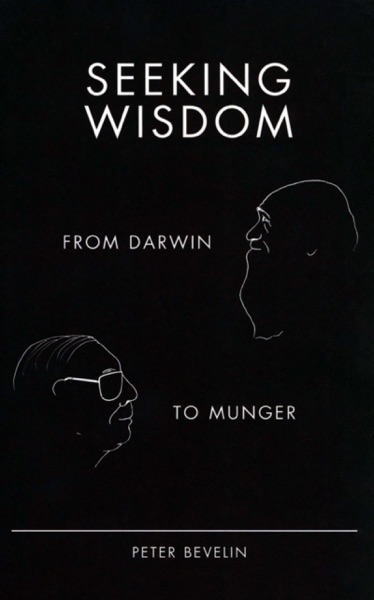
Talk to Seeking Wisdom: From Darwin to Munger like its author wrote you back.
Get the ideas that fit your life — not generic summaries.
- Chat with the book
- Audiobook-style main ideas
- Adapts to your life and goals
- Helps you take action
What it argues
Seeking Wisdom is Peter Bevelin's distillation of ideas from Charles Darwin, Charlie Munger, and a wide range of scientific and philosophical disciplines — assembled into a practical guide for better thinking and decision-making. The book is less a linear argument than an organized anthology of wisdom, structured around understanding why humans think poorly and what can be done about it.
The first half maps the psychology of misjudgment: the cognitive biases, emotional shortcuts, and social pressures that lead rational people to make irrational decisions. Bevelin draws heavily on Munger's famous list of human misthinking tendencies — social proof, liking bias, contrast misreaction, reciprocity, incentive-caused bias — and supplements them with evidence from psychology, biology, and evolutionary theory. The underlying claim is that evolution built our brains to survive on the savanna, not to manage a stock portfolio or run a company, and most of our mistakes trace back to that mismatch.
What it gets right
- 1.
Our brains evolved for survival, not for rational decision-making. Most cognitive errors are features of an ancestral environment that no longer apply.
- 2.
Charlie Munger's latticework of mental models: wisdom comes from combining frameworks across multiple disciplines, not mastering a single one.
- 3.
Social proof, liking bias, and incentive-caused bias are among the most dangerous cognitive tendencies because they feel like reasoning while being the opposite.
What it covers
Who wrote it
Peter Bevelin is a Swedish author and investor whose work focuses on the psychology of decision-making and the application of multidisciplinary thinking to business and investing. He has been associated with the Berkshire Hathaway and Buffett orbit of value investors, and Seeking Wisdom was developed over many years as a personal reference guide before being published. He has also written A Few Lessons for Investors and Managers, a shorter companion volume drawn from Warren Buffett's letters and annual meetings.
