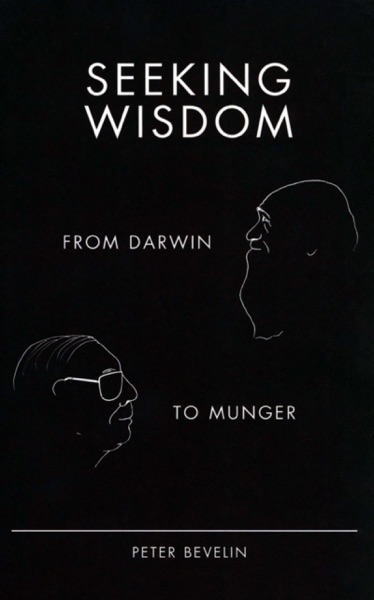
Seeking Wisdom: From Darwin to Munger by Peter Bevelin is a 2003 philosophy book about mental models, decision-making, rationality. Our brains evolved for survival, not for rational decision-making. Most cognitive errors are features of an ancestral environment that no longer apply.
Summary
Seeking Wisdom is Peter Bevelin's distillation of ideas from Charles Darwin, Charlie Munger, and a wide range of scientific and philosophical disciplines — assembled into a practical guide for better thinking and decision-making. The book is less a linear argument than an organized anthology of wisdom, structured around understanding why humans think poorly and what can be done about it.
The first half maps the psychology of misjudgment: the cognitive biases, emotional shortcuts, and social pressures that lead rational people to make irrational decisions. Bevelin draws heavily on Munger's famous list of human misthinking tendencies — social proof, liking bias, contrast misreaction, reciprocity, incentive-caused bias — and supplements them with evidence from psychology, biology, and evolutionary theory. The underlying claim is that evolution built our brains to survive on the savanna, not to manage a stock portfolio or run a company, and most of our mistakes trace back to that mismatch.
The second half shifts to remedies: the mental models Bevelin argues every serious thinker should internalize. Mathematics (particularly probabilistic thinking), physics, chemistry, biology, and social science each contribute frameworks that help cut through confusion. Munger's concept of the latticework of mental models runs throughout — the idea that wisdom comes from holding many explanatory lenses simultaneously and applying the right one to each situation, rather than trying to force every problem through a single discipline's framework.
The book wears its influences openly. Munger is quoted throughout, Darwin is treated as the patron saint of patient, evidence-based reasoning, and Bevelin is unabashedly a synthesizer rather than an original theorist. This is a feature, not a flaw: the value here is curation. Seeking Wisdom is dense, reference-heavy, and not designed to be read quickly. Readers who approach it as a working reference — returning to sections as relevant situations arise — will get more from it than those who read cover to cover once and move on.
Talk to Seeking Wisdom: From Darwin to Munger like its author wrote you back.
Get the ideas that fit your life — not generic summaries.
- Chat with the book
- Audiobook-style main ideas
- Adapts to your life and goals
- Helps you take action
Key takeaways
- 1.
Our brains evolved for survival, not for rational decision-making. Most cognitive errors are features of an ancestral environment that no longer apply.
- 2.
Charlie Munger's latticework of mental models: wisdom comes from combining frameworks across multiple disciplines, not mastering a single one.
- 3.
Social proof, liking bias, and incentive-caused bias are among the most dangerous cognitive tendencies because they feel like reasoning while being the opposite.
- 4.
The best decisions come from inverting problems — ask what you want to avoid and work backward — as much as from trying to get directly to what you want.
- 5.
Probabilistic thinking is essential. Most people treat low-probability events as either impossible or inevitable, when the real question is: at what base rate does this happen?
- 6.
Darwin's method: search actively for disconfirming evidence. The brain naturally ignores or reinterprets evidence that conflicts with existing beliefs.
- 7.
Simplicity is a virtue in both thinking and decision-making. The first step to getting a right answer is often eliminating the categories of wrong answers.
- 8.
Understanding what motivates people — especially when incentives are misaligned — is more predictive than intelligence or good intentions.
Discussion questions
Use these on your own, with a book club, or as chat starters in Superbook. Book club version, ready to copy or print →
- 1.
Munger argues that multiple mental models are necessary for clear thinking. Which mental model from outside your primary field has been most useful to you, and where did you pick it up?
- 2.
Bevelin emphasizes inversion — working backward from failure rather than forward from goals. Which current problem in your life might benefit most from inversion?
- 3.
The book lists social proof as one of the most powerful biases. Can you think of a time you followed a crowd and later realized the crowd was wrong?
- 4.
Incentive-caused bias shapes how professionals advise clients in ways clients often don't notice. Where in your life might you be receiving advice that is subtly distorted by the advisor's incentives?
- 5.
Darwin is held up as a model of rigorous intellectual honesty. What would it mean, concretely, to apply the same discipline to a belief you hold strongly today?
- 6.
The book argues that evolution explains many of our irrational tendencies. Does that explanation change how much you hold yourself or others responsible for cognitive errors?
- 7.
Bevelin quotes Munger extensively on the dangers of ideology. Where in your own thinking do you rely on ideological frameworks as shortcuts rather than examining cases individually?
- 8.
Probabilistic thinking suggests you should update beliefs as new evidence arrives. What is a belief you've held for years that you've never seriously stress-tested?
- 9.
The concept of a latticework of models implies that specialists without breadth are at a systematic disadvantage. Do you think this applies in your field?
- 10.
The book treats simplicity as a goal. What is something you currently think about in a complicated way that might actually be simple once the right framework is applied?
- 11.
How do you personally guard against the confirmation bias — the tendency to notice evidence that supports your views and discount evidence that doesn't?
- 12.
Munger and Bevelin both emphasize learning from the mistakes of others rather than your own. What's the most useful thing you've learned from someone else's mistake?
Themes
Frequently asked questions
-
Is Seeking Wisdom worth reading?
Yes, if you are serious about improving your reasoning and you already have some background in investing or behavioral economics. It is denser and less narrative than most popular nonfiction, which makes it rewarding but also demanding. Readers who want something more accessible should start with Poor Charlie's Almanack first.
-
How is Seeking Wisdom different from Poor Charlie's Almanack?
Poor Charlie's Almanack is Munger's own words — speeches, interviews, and talks collected and arranged. Seeking Wisdom is Bevelin's synthesis of Munger's ideas alongside Darwin, evolutionary biology, and psychology. Bevelin provides more structure and original context; Munger's book is richer in voice and character.
-
What level of reader is Seeking Wisdom aimed at?
Experienced readers who already think seriously about decision-making and want a reference text. It is not a beginner's book. The prose is clear but the density of ideas is high, and some sections assume familiarity with probability, investing, and evolutionary biology.
-
What is the most actionable idea in Seeking Wisdom?
Inversion: whenever you face a difficult decision or goal, spend time explicitly identifying what failure looks like and what actions or mindsets would lead there — then avoid those. Munger attributes much of his success to this habit, and it is straightforward enough to apply immediately.
-
How long is Seeking Wisdom?
The book runs to roughly 300 pages in its later editions, making it a moderate-length read at around five to six hours. Many readers find themselves rereading sections rather than moving straight through, which extends engagement considerably.