Business · Book club
Shape Up book club questions
Here are 12 book club questions for Shape Up by Ryan Singer, ordered to open easily and end somewhere worth arguing about. Copy them, print them, or bring them up one at a time.
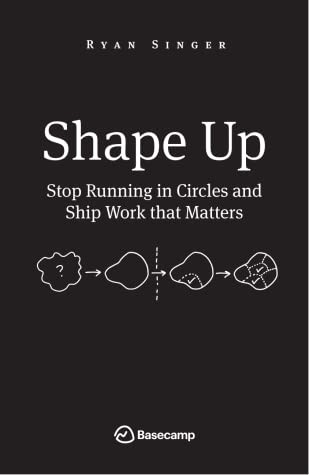
Shape Up is Ryan Singer's account of how Basecamp builds software — a methodology developed over fifteen years and refined through hundreds of product cycles.
Ryan Singer · 2019 · 3h 40m
Full summary and key takeaways →The 12 questions
- 1.
Singer argues that a backlog creates a false sense of commitment and becomes politically toxic over time. Does that match your experience? What would eliminating your team's backlog actually cost?
- 2.
The appetite concept replaces estimation with intentional time-boxing. Is that a realistic shift in most organizations, or does it require a specific kind of authority at the top?
- 3.
Shape Up was developed at Basecamp, a small, profitable company with no external investors. How much of the methodology depends on organizational conditions that most teams don't have?
- 4.
The hill chart metaphor distinguishes figuring-out from executing. Have you worked on projects where that distinction was unclear, and what happened?
- 5.
Singer is explicit that shaped work is not a specification — it leaves room for the team to solve problems their own way. What needs to be true about a team for that latitude to work well?
- 6.
What would change if your team moved from two-week sprints to six-week cycles? What would you gain, and what would you lose?
- 7.
The book argues that unfinished work at the end of a cycle should not automatically roll over. How do you distinguish between abandoning something genuinely incomplete and making a good scope decision?
- 8.
Shape Up puts significant responsibility on shapers to do the hard thinking before the development team sees a problem. What happens when shaping is done badly?
- 9.
Singer says the methodology works for Basecamp but may not apply directly elsewhere. What are the minimum conditions under which you think it would transfer?
- 10.
The book is free and published online rather than as a traditional business book. What do you think Basecamp gains from giving it away, and what does that say about how the company thinks about IP and knowledge?
- 11.
How does Shape Up's approach to feature decisions compare to how your own organization decides what to build? Where do you see the biggest gaps?
- 12.
Singer distinguishes between raw ideas (unready to build) and shaped work (ready to bet). In the projects you've been part of, which phase is usually rushed, and what did that cost?
How to run the discussion
- Pick six to eight, not all of them. An hour of real discussion covers fewer questions than anyone expects, and racing the list is what makes a book club feel like homework.
- Open with what people noticed, not what they concluded. Asking for a verdict first hardens opinions before anyone has heard each other.
- Let the disagreement run. The questions below that split a room are the ones worth the time; the ones everyone answers the same way can be skipped.
- Ask the quiet person a specific question. A direct, narrow question is far easier to answer than an open invitation to contribute.
Themes worth steering toward
If the conversation stalls, these are the threads that usually restart it.
Common questions
What are good book club questions for Shape Up?
Here are 12 book club questions for Shape Up by Ryan Singer, ordered to open easily and end somewhere worth arguing about. The strongest openers ask what each reader noticed rather than what they concluded, and the discussion usually turns on product development, project management, software teams.
How long should a book club discussion of Shape Up last?
Most groups run 60 to 90 minutes of actual discussion. That is roughly six to eight questions, not all of them, so pick the ones that suit your group rather than working down the list in order.
What are the main themes in Shape Up?
Product development, Project management, Software teams, Decision-making, Scope and prioritization. Those are the threads most likely to divide a room, which makes them the useful places to steer a discussion that has gone quiet.
Picking the next one? See books like Shape Up or questions for other book club picks.
