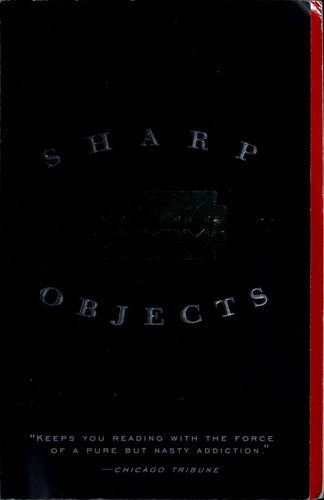
Talk to Sharp Objects like its author wrote you back.
Get the ideas that fit your life — not generic summaries.
- Chat with the book
- Audiobook-style main ideas
- Adapts to your life and goals
- Helps you take action
Sharp Objects, in detail
Reporter Camille Preaker is sent back to Wind Gap, Missouri — the small town she escaped a decade earlier — to cover the murders of two young girls. She moves back into her mother Adora's gothic Victorian house, into the suffocating orbit of a woman who has always controlled Camille through illness and appearance. Camille has her own history: words carved into her skin, every inch of her body a lexicon of self-harm. She drinks too much, trusts no one, and begins to piece together what Wind Gap is hiding while navigating the pull of a town and a family she has very good reasons to have left.
Sharp Objects is Flynn's debut and the most Southern Gothic of her three novels — Wind Gap has the heat, the decay, and the female cruelty of that tradition without its nostalgia. Flynn is interested in how small towns use gossip and hierarchy to enforce conformity, and in the specific ways mothers can harm daughters while performing love. The novel builds toward a revelation about Adora that arrives as confirmation of what the reader has suspected rather than as surprise, and then adds a final twist that is genuinely shocking and reframes the entire book.
What makes Sharp Objects distinctive even among Flynn's work is the body writing — the physical fact of Camille's scars, the words she cut into herself as a teenager, and how that history sits under every scene. Flynn doesn't use it as shock value; it's the externalization of what Camille couldn't say, and the novel keeps returning to what it means to write on your own skin rather than in words.
Flynn's debut is rougher than her later books — the pace drags in places and Wind Gap's secondary characters are sketched thinner than her later ensembles. But the core of Camille and Adora is as precisely observed as anything Flynn has written. Readers interested in female Gothic, maternal ambivalence, or the specific violence of the domestic sphere will find this one of the decade's most unnerving psychological portraits. The HBO adaptation with Amy Adams captures the mood but the novel's interiority — Camille's voice — is the richer version.
The big ideas
- 1.
Munchausen by proxy — Adora's form of harm — is explored here not as a twist but as a texture, present throughout the novel in Adora's language and behavior before it's named.
- 2.
Camille's self-harm is treated as a private language, a way of marking experience when other forms of expression failed. Flynn doesn't moralize it or resolve it neatly.
- 3.
Wind Gap functions as a collective antagonist: the town's social order, its gossip, its enforcement of femininity is as dangerous as any individual character.
