Science · Book club
Six Easy Pieces book club questions
Here are 11 book club questions for Six Easy Pieces by Richard P. Feynman, ordered to open easily and end somewhere worth arguing about. Copy them, print them, or bring them up one at a time.
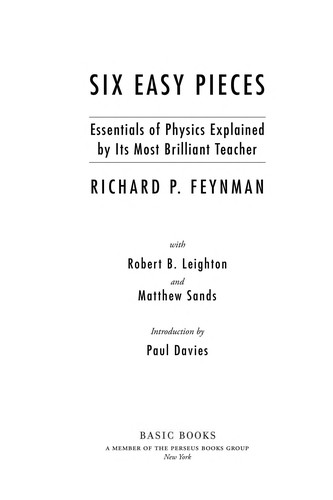
Six Easy Pieces is a selection of six lectures from Richard Feynman's legendary Caltech introductory physics course, delivered in 1961–62 and published in full as The Feynman Lectures on Physics.
Richard P. Feynman · 1994 · 3h 45m
Full summary and key takeaways →The 11 questions
- 1.
Feynman says the atomic hypothesis is the most important scientific idea. Do you agree, or is there another idea that deserves that distinction?
- 2.
He claims nobody understands quantum mechanics. Is that honesty about the limits of human intuition liberating or disturbing?
- 3.
The book presents physics as the most fundamental science, with other sciences as applications. Does that hierarchy feel right to you? What does it leave out?
- 4.
Conservation of energy seems simple but has deep implications. Had you thought about it before as a deep principle rather than just a rule for solving problems?
- 5.
Feynman draws consistent connections between formal physics and everyday phenomena. What's an example from your life where a physics principle explains something you've observed?
- 6.
The double-slit experiment shows that observing a particle changes its behavior. What does that dependence of outcome on observation say about the nature of physical reality?
- 7.
How does Feynman's teaching style — conversational, with explicit acknowledgment of what he doesn't know — differ from how physics was taught to you?
- 8.
He argues that physicists don't know what energy really is, only how to calculate with it. Does that distinction between calculation and understanding matter?
- 9.
Feynman's criterion for understanding is the ability to explain simply. Is that always achievable, or are there genuine cases where simple explanation requires distortion?
- 10.
Which of the six lectures did you find most accessible, and which most challenging?
- 11.
Feynman opens with atoms rather than motion or force, which is the more traditional entry point for introductory physics. Why might he have made that choice?
How to run the discussion
- Pick six to eight, not all of them. An hour of real discussion covers fewer questions than anyone expects, and racing the list is what makes a book club feel like homework.
- Open with what people noticed, not what they concluded. Asking for a verdict first hardens opinions before anyone has heard each other.
- Let the disagreement run. The questions below that split a room are the ones worth the time; the ones everyone answers the same way can be skipped.
- Ask the quiet person a specific question. A direct, narrow question is far easier to answer than an open invitation to contribute.
Themes worth steering toward
If the conversation stalls, these are the threads that usually restart it.
Common questions
What are good book club questions for Six Easy Pieces?
Here are 11 book club questions for Six Easy Pieces by Richard P. Feynman, ordered to open easily and end somewhere worth arguing about. The strongest openers ask what each reader noticed rather than what they concluded, and the discussion usually turns on physics, atoms, quantum mechanics.
How long should a book club discussion of Six Easy Pieces last?
Most groups run 60 to 90 minutes of actual discussion. That is roughly six to eight questions, not all of them, so pick the ones that suit your group rather than working down the list in order.
What are the main themes in Six Easy Pieces?
Physics, Atoms, Quantum mechanics, Conservation laws, Scientific thinking. Those are the threads most likely to divide a room, which makes them the useful places to steer a discussion that has gone quiet.
Picking the next one? See books like Six Easy Pieces or questions for other book club picks.
