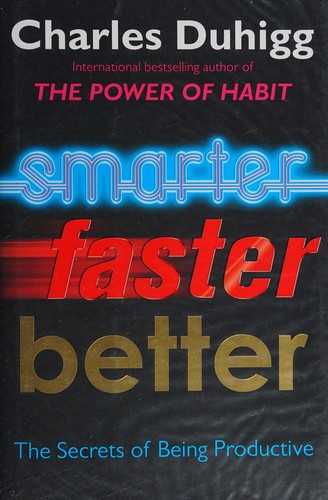
Talk to Smarter Faster Better like its author wrote you back.
Get the ideas that fit your life — not generic summaries.
- Chat with the book
- Audiobook-style main ideas
- Adapts to your life and goals
- Helps you take action
What it argues
Smarter Faster Better is Duhigg's follow-up to The Power of Habit, turning from habitual behavior to the science of productive decision-making and sustained motivation. The book is organized around eight concepts — motivation, teams, focus, goal setting, managing others, decision-making, innovation, and absorbing data — each grounded in a case study and the academic research that explains it.
Duhigg's reporting is the book's chief strength. The case studies range from a Marine training reform that discovered cognitive autonomy, not punishment, produces better soldiers; to Google's Project Aristotle, which found that psychological safety — not individual skill or management structure — was the primary predictor of team effectiveness; to the cognitive framework that helps nurses and pilots make better decisions under uncertainty.
What it gets right
- 1.
Motivation is connected to agency: people work harder when they believe they are in control of their behavior, not when they are told to work harder. Small choices that affirm autonomy prime the motivational system.
- 2.
Team performance is primarily determined by psychological safety — the norm of interpersonal risk-taking — not by individual talent or team composition. Google's Project Aristotle confirmed this finding.
- 3.
Stretch goals and SMART goals are both necessary and serve different functions. Stretch goals provide direction and generate breakthrough thinking; SMART goals provide the executable plan.
What it covers
Who wrote it
Charles Duhigg is an American journalist and Pulitzer Prize-winning reporter who spent more than a decade at The New York Times. The Power of Habit (2012) made him widely known as a science journalist who could make behavioral research accessible and useful for a general audience. Smarter Faster Better, published in 2016, extends his investigation from habits to the broader science of productivity and decision-making. He has since written The Quiet Place and continues to write for publications including The Atlantic.
