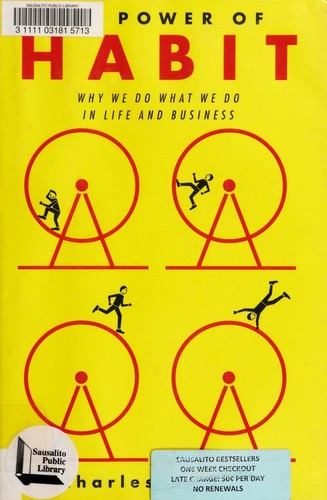
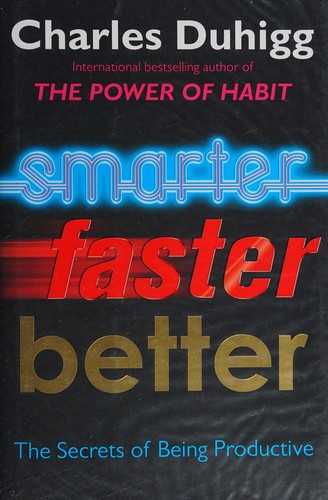
Smarter Faster Better by Charles Duhigg is a 2016 self-help book about productivity, decision making, motivation. Motivation is connected to agency: people work harder when they believe they are in control of their behavior, not when they are told to work harder. Small choices that affirm autonomy prime the motivational system.
Summary
Smarter Faster Better is Duhigg's follow-up to The Power of Habit, turning from habitual behavior to the science of productive decision-making and sustained motivation. The book is organized around eight concepts — motivation, teams, focus, goal setting, managing others, decision-making, innovation, and absorbing data — each grounded in a case study and the academic research that explains it.
Duhigg's reporting is the book's chief strength. The case studies range from a Marine training reform that discovered cognitive autonomy, not punishment, produces better soldiers; to Google's Project Aristotle, which found that psychological safety — not individual skill or management structure — was the primary predictor of team effectiveness; to the cognitive framework that helps nurses and pilots make better decisions under uncertainty.
The goal-setting chapter is particularly useful: Duhigg describes the tension between stretch goals and SMART goals, arguing that stretch goals produce breakthroughs but SMART goals provide the detailed plan for executing them. The optimal approach is to use stretch goals for direction and SMART goals for daily action — a combination that most practitioners use either/or rather than together.
Duhigg's treatment of focus introduces mental models and probabilistic thinking as practices that distinguish effective decision-makers from less effective ones. He argues that the ability to construct a scenario for what you expect to happen, and then to notice when reality diverges from that scenario, is a trainable skill that improves decision quality across domains. Like The Power of Habit, the book is accessible and well-reported, though some reviewers find the chapter structure too formulaic.
Talk to Smarter Faster Better like its author wrote you back.
Get the ideas that fit your life — not generic summaries.
- Chat with the book
- Audiobook-style main ideas
- Adapts to your life and goals
- Helps you take action
Key takeaways
- 1.
Motivation is connected to agency: people work harder when they believe they are in control of their behavior, not when they are told to work harder. Small choices that affirm autonomy prime the motivational system.
- 2.
Team performance is primarily determined by psychological safety — the norm of interpersonal risk-taking — not by individual talent or team composition. Google's Project Aristotle confirmed this finding.
- 3.
Stretch goals and SMART goals are both necessary and serve different functions. Stretch goals provide direction and generate breakthrough thinking; SMART goals provide the executable plan.
- 4.
Mental models — scenarios you build for what you expect to happen — improve decision quality by making it easier to notice when reality is diverging from expectation before the divergence becomes a crisis.
- 5.
Focus is a choice: effective people actively choose what to attend to and ignore rather than allowing their attention to be directed by incoming stimuli.
- 6.
Information overload is managed through selective attention and active data structuring. The people who best absorb large amounts of information are those who actively organize it as they receive it.
- 7.
Innovation often comes from combining existing ideas in new ways, and the people most likely to do this are those who move between different creative communities rather than staying inside one.
- 8.
Making decisions requires acknowledging uncertainty explicitly. People who force themselves to assign probabilities to outcomes make better decisions than those who think in binaries.
Discussion questions
Use these on your own, with a book club, or as chat starters in Superbook. Book club version, ready to copy or print →
- 1.
Duhigg argues that motivation is built through agency, not praise. Where in your life could you reframe obligations to emphasize choice rather than compulsion?
- 2.
Google's Project Aristotle found that psychological safety was the primary predictor of team effectiveness. How safe is it to take interpersonal risks in your current team or organization?
- 3.
What is the stretch goal most important to you right now? What would the SMART goals that implement it look like?
- 4.
Have you ever built an explicit mental model before a complex decision — a scenario for what you expected to happen? How did reality compare?
- 5.
Where in your work are you currently reactive to incoming information rather than choosing what to focus on? What would choosing look like?
- 6.
Duhigg covers the story of the Cincinnati teacher who got students to engage with data by having them create it. What would it mean to create data actively about something you're trying to understand rather than just receiving it?
- 7.
The Marine training reform that used cognitive autonomy produced better soldiers than punishment-based training. What does that suggest about how you develop people around you?
- 8.
The innovation chapter describes people who cross communities as more likely to produce breakthroughs. How siloed is your current professional world? What community are you not currently part of that might offer new combinations?
- 9.
Probabilistic thinking requires explicitly acknowledging uncertainty. Where in your current work are you treating uncertain outcomes as binary when they're actually probabilistic?
- 10.
Duhigg's case studies involve disasters (plane crashes, data processing failures) as well as successes. What near-miss or small failure in your own work contains a lesson you haven't fully absorbed?
- 11.
Which of the eight concepts — motivation, teams, focus, goals, managing others, decisions, innovation, data — is the most critical gap in your current effectiveness?
- 12.
The book suggests that the practices of highly effective people are learnable, not innate. Which specific practice described in the book would most change your output if you implemented it consistently?
Themes
Frequently asked questions
-
Is Smarter Faster Better worth reading?
Yes if you enjoyed The Power of Habit and want Duhigg's approach applied to a wider range of productivity questions. It is well-reported, accessibly written, and covers territory — psychological safety, decision-making under uncertainty, stretch goals — that is genuinely useful. Some readers find the chapter structure formulaic, but the individual chapters stand on their own.
-
How long does it take to read Smarter Faster Better?
About five hours. The book is organized as independent chapters, each structured as a narrative case study followed by the research explanation. You can read it straight through or focus on the chapters most relevant to your situation.
-
What is the main idea of Smarter Faster Better?
Productivity is not about doing more things faster — it is about making better choices about what to focus on, building environments that support motivation and team performance, and making decisions with explicit acknowledgment of uncertainty. The research suggests these are learnable skills.
-
How does Smarter Faster Better compare to The Power of Habit?
The Power of Habit has a more unified central thesis (the habit loop) and is more tightly argued. Smarter Faster Better covers more ground and is more varied. Both are strong examples of science journalism; The Power of Habit is more re-readable; Smarter Faster Better is broader.
-
Who should read Smarter Faster Better?
Managers, team leaders, and knowledge workers who want research-grounded perspectives on motivation, team dynamics, goal-setting, and decision quality. Also useful for anyone who has read The Power of Habit and wants more Duhigg.