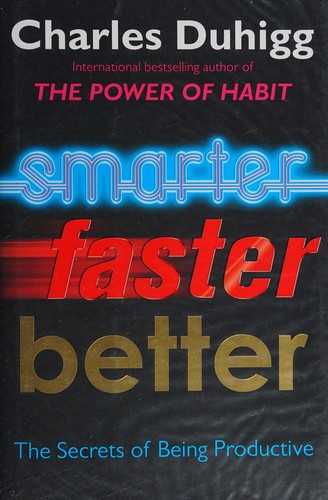
Talk to Smarter Faster Better like its author wrote you back.
Get the ideas that fit your life — not generic summaries.
- Chat with the book
- Audiobook-style main ideas
- Adapts to your life and goals
- Helps you take action
Smarter Faster Better, in detail
Smarter Faster Better is Duhigg's follow-up to The Power of Habit, turning from habitual behavior to the science of productive decision-making and sustained motivation. The book is organized around eight concepts — motivation, teams, focus, goal setting, managing others, decision-making, innovation, and absorbing data — each grounded in a case study and the academic research that explains it.
Duhigg's reporting is the book's chief strength. The case studies range from a Marine training reform that discovered cognitive autonomy, not punishment, produces better soldiers; to Google's Project Aristotle, which found that psychological safety — not individual skill or management structure — was the primary predictor of team effectiveness; to the cognitive framework that helps nurses and pilots make better decisions under uncertainty.
The goal-setting chapter is particularly useful: Duhigg describes the tension between stretch goals and SMART goals, arguing that stretch goals produce breakthroughs but SMART goals provide the detailed plan for executing them. The optimal approach is to use stretch goals for direction and SMART goals for daily action — a combination that most practitioners use either/or rather than together.
Duhigg's treatment of focus introduces mental models and probabilistic thinking as practices that distinguish effective decision-makers from less effective ones. He argues that the ability to construct a scenario for what you expect to happen, and then to notice when reality diverges from that scenario, is a trainable skill that improves decision quality across domains. Like The Power of Habit, the book is accessible and well-reported, though some reviewers find the chapter structure too formulaic.
The big ideas
- 1.
Motivation is connected to agency: people work harder when they believe they are in control of their behavior, not when they are told to work harder. Small choices that affirm autonomy prime the motivational system.
- 2.
Team performance is primarily determined by psychological safety — the norm of interpersonal risk-taking — not by individual talent or team composition. Google's Project Aristotle confirmed this finding.
- 3.
Stretch goals and SMART goals are both necessary and serve different functions. Stretch goals provide direction and generate breakthrough thinking; SMART goals provide the executable plan.
