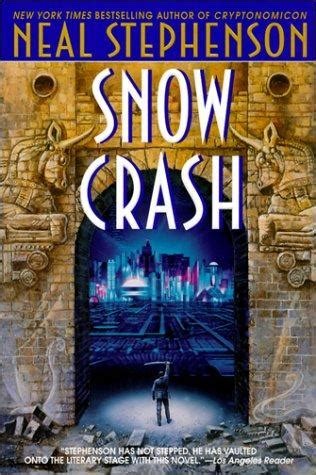
Talk to Snow Crash like its author wrote you back.
Get the ideas that fit your life — not generic summaries.
- Chat with the book
- Audiobook-style main ideas
- Adapts to your life and goals
- Helps you take action
Snow Crash, in detail
Hiro Protagonist — yes, that's his name — is a freelance hacker and part-time pizza deliveryman in a near-future America that has fractured into private corporate enclaves. Nation-states have been replaced by branded franchises: Mr. Lee's Greater Hong Kong, the Mafia, evangelical megachurches. The federal government is a tiny footnote. Hiro spends most of his time in the Metaverse — a virtual reality internet that Stephenson essentially invented with this novel — where he is a famous sword-fighter and information broker.
When a new drug called Snow Crash appears, operating simultaneously as a computer virus and a brain-altering pathogen, Hiro begins investigating a conspiracy that reaches back to ancient Sumer, the earliest known civilization, and a theory that language itself is a form of programming — that the first written language was a kind of code that could directly alter human behavior, and that someone has figured out how to reactivate it.
Snow Crash is two things held together with enormous narrative energy: a satirical comedy about near-future American capitalism, and a genuinely ambitious intellectual argument about language, religion, and the structure of the mind. The satire is caustic and funny — the franchise America, the Mafia pizza delivery with guaranteed thirty-minute arrival under penalty of corporate violence, the Burbclaves with their HOA covenants enforced by private security. The linguistics plot is strange and takes some work, but it pays off if you follow it.
Stephenson writes at speed, with tremendous fun and occasional self-indulgence. The novel is long and the middle section devoted to Sumerian linguistic theory is genuinely dense. Some readers find the last third, which accelerates into action movie territory, thematically light after the intellectual ambition of what preceded it. But the energy is high throughout and the ideas are genuinely original — Snow Crash invented the word "avatar" in its computing sense and predicted the Metaverse so precisely that Mark Zuckerberg cited it as an inspiration.
The big ideas
- 1.
Stephenson coined 'avatar' in its digital sense and described a Metaverse with VR real estate, social hierarchies, and user-generated content thirty years before Meta built its version — and largely got the dynamics right.
- 2.
The novel's core idea — that language is a form of programming that can hack the brain directly — is not standard linguistics, but it's a productive metaphor for how memetic systems spread and control behavior.
- 3.
Franchise America — a country organized as competing brand enclaves rather than a government — is Stephenson's extrapolation of privatization and the erosion of public institutions taken to its logical endpoint.
