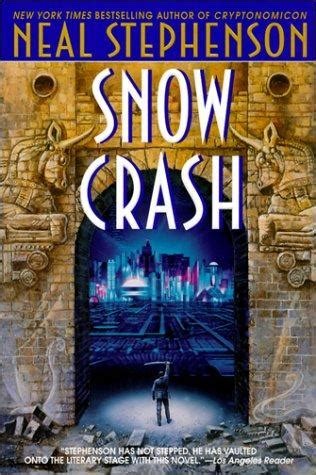
Snow Crash by Neal Stephenson is a 1992 science fiction book about language and cognition, corporate feudalism, virtual reality. Stephenson coined 'avatar' in its digital sense and described a Metaverse with VR real estate, social hierarchies, and user-generated content thirty years before Meta built its version — and largely got the dynamics right.
Summary
Hiro Protagonist — yes, that's his name — is a freelance hacker and part-time pizza deliveryman in a near-future America that has fractured into private corporate enclaves. Nation-states have been replaced by branded franchises: Mr. Lee's Greater Hong Kong, the Mafia, evangelical megachurches. The federal government is a tiny footnote. Hiro spends most of his time in the Metaverse — a virtual reality internet that Stephenson essentially invented with this novel — where he is a famous sword-fighter and information broker.
When a new drug called Snow Crash appears, operating simultaneously as a computer virus and a brain-altering pathogen, Hiro begins investigating a conspiracy that reaches back to ancient Sumer, the earliest known civilization, and a theory that language itself is a form of programming — that the first written language was a kind of code that could directly alter human behavior, and that someone has figured out how to reactivate it.
Snow Crash is two things held together with enormous narrative energy: a satirical comedy about near-future American capitalism, and a genuinely ambitious intellectual argument about language, religion, and the structure of the mind. The satire is caustic and funny — the franchise America, the Mafia pizza delivery with guaranteed thirty-minute arrival under penalty of corporate violence, the Burbclaves with their HOA covenants enforced by private security. The linguistics plot is strange and takes some work, but it pays off if you follow it.
Stephenson writes at speed, with tremendous fun and occasional self-indulgence. The novel is long and the middle section devoted to Sumerian linguistic theory is genuinely dense. Some readers find the last third, which accelerates into action movie territory, thematically light after the intellectual ambition of what preceded it. But the energy is high throughout and the ideas are genuinely original — Snow Crash invented the word "avatar" in its computing sense and predicted the Metaverse so precisely that Mark Zuckerberg cited it as an inspiration.
Talk to Snow Crash like its author wrote you back.
Get the ideas that fit your life — not generic summaries.
- Chat with the book
- Audiobook-style main ideas
- Adapts to your life and goals
- Helps you take action
Key takeaways
- 1.
Stephenson coined 'avatar' in its digital sense and described a Metaverse with VR real estate, social hierarchies, and user-generated content thirty years before Meta built its version — and largely got the dynamics right.
- 2.
The novel's core idea — that language is a form of programming that can hack the brain directly — is not standard linguistics, but it's a productive metaphor for how memetic systems spread and control behavior.
- 3.
Franchise America — a country organized as competing brand enclaves rather than a government — is Stephenson's extrapolation of privatization and the erosion of public institutions taken to its logical endpoint.
- 4.
The Mafia's legitimacy in the novel (they run pizza delivery and are respected franchisors) is one of the cleanest jokes: in a world without functional government, organized crime becomes just another corporation.
- 5.
Y.T. (Yours Truly), the teenage skateboard courier, is arguably more interesting than Hiro — she navigates the novel's world with more adaptability and less ideology, and her sections are often the sharpest.
- 6.
The L. Bob Rife character — a charismatic media mogul using ancient Sumerian neurolinguistics to create a cult — is a specific satire of televangelism and media empire, but reads just as cleanly as a portrait of tech-platform charisma in 2026.
- 7.
Stephenson is making an argument about the relationship between information and power: whoever controls the base-level code — whether of software or of human cognition — controls everything built on top of it.
- 8.
The novel treats the internet as both the most democratic and the most controllable technology ever invented — simultaneously liberation infrastructure and the perfect tool for whoever figures out its deepest layer.
Discussion questions
Use these on your own, with a book club, or as chat starters in Superbook. Book club version, ready to copy or print →
- 1.
The premise that language can function as a neurolinguistic virus requires a lot of suspension of disbelief. Did Stephenson earn that premise with enough internal consistency, or did the linguistics plot strain credibility?
- 2.
Hiro is ostensibly the protagonist but Y.T. is often more interesting. Is that a structural miscalculation by Stephenson, or is the dual protagonist structure doing something deliberate?
- 3.
Franchise America is comic but also a genuine extrapolation. Which current trends does it most accurately describe, and which feels most exaggerated?
- 4.
The Mafia as a legitimate franchise is one of the novel's best jokes. But it also makes a serious point about the relationship between organized crime and legitimate business. What is that point?
- 5.
The Metaverse in Snow Crash has VR real estate hierarchies and status games. Meta's Metaverse largely failed. What did Stephenson get right, and what did he get wrong about how people would actually use a shared virtual world?
- 6.
The novel's last third accelerates into action-thriller mode. Did that tonal shift work for you, or did it feel like Stephenson losing confidence in his ideas?
- 7.
L. Bob Rife uses information control as a tool for mass mind management. Which current technology or media platform does he most remind you of?
- 8.
Stephenson has been criticized for his female characters — Y.T. is strong but also subject to a sexual assault scene that the novel handles awkwardly. Does how he handles that scene affect your reading of the novel?
- 9.
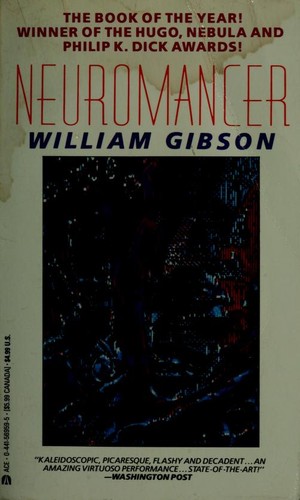
Compared to Neuromancer — also a cyberpunk classic, also about AI and corporate power — where does Snow Crash land harder? Where does it feel weaker?
- 10.
The novel argues that religion and language are both forms of brain programming. Is that reductive, or does it capture something real about how belief systems spread?
- 11.
Snow Crash is very funny in its first half. Is the humor compatible with the serious ideas it's exploring, or does it undercut them?
- 12.
Stephenson coined the term Metaverse. Does it matter that the real Metaverse turned out nothing like his version — was he wrong, or just early?
Themes
Frequently asked questions
-
Is Snow Crash worth reading in 2026?
Yes, particularly if you want to understand where the Metaverse idea came from and what its inventor actually thought it would be. The satire of franchise capitalism and digital culture reads as sharper now than it did in 1992 in many respects. The linguistics plot is strange but rewarding.
-
Is Snow Crash hard to read?
The first hundred pages are some of the most propulsive in science fiction. The middle section, covering Sumerian neurolinguistics, is dense and requires patience. The final third is action-movie paced. Overall it's accessible rather than difficult, but it is very long.
-
What is the Metaverse in Snow Crash?
A shared virtual reality internet where users appear as avatars, own VR real estate, conduct business, and socialize. Stephenson described it in 1992 — including the social dynamics of VR status — thirty years before technology companies attempted to build it.
-
Do I need to know anything about Sumerian history to enjoy Snow Crash?
No prior knowledge needed. Stephenson explains the relevant pieces through Hiro's research. Readers with existing knowledge of ancient Near Eastern religion and languages may find the neurolinguistics sections more engaging, but they're designed to be accessible.
-
Who shouldn't read Snow Crash?
Readers who need tight, economical narrative will find Stephenson's instinct to pursue every interesting tangent frustrating. The novel is long, occasionally self-indulgent, and the tonal whiplash between comedy and serious ideas doesn't work for everyone. Also, one scene involving Y.T. is a depiction of sexual assault that many readers find troubling in how the novel subsequently handles it.