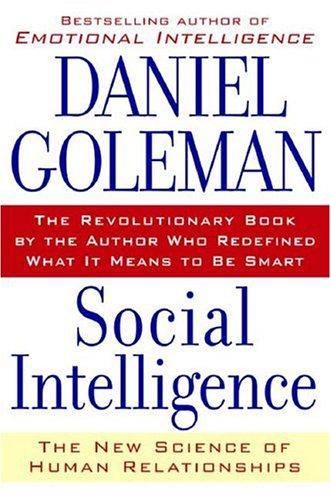
Talk to Social Intelligence: The New Science of Human Relationships like its author wrote you back.
Get the ideas that fit your life — not generic summaries.
- Chat with the book
- Audiobook-style main ideas
- Adapts to your life and goals
- Helps you take action
What it argues
Daniel Goleman's follow-up to Emotional Intelligence shifts focus from the inner world to the social. Where emotional intelligence is about managing your own feelings, social intelligence is about what happens in the space between people — the mostly unconscious processes by which we read, influence, and are shaped by others. Goleman draws heavily on the then-emerging field of social neuroscience, particularly research on mirror neurons and the brain's dedicated social circuits, to argue that our brains are wired for connection in ways that are more fundamental than previously understood.
The book's central claim is that relationships are not merely psychological but biological. Sustained toxic relationships produce measurable changes in stress hormones, immune function, and brain structure. Sustained nurturing relationships do the opposite. The people we spend time with literally reshape us physiologically, and the effects accumulate over a lifetime. Goleman calls this "interpersonal neurobiology."
What it gets right
- 1.
The brain has dedicated social circuits, including regions involved in reading faces, voices, and intentions, that operate largely beneath conscious awareness and respond faster than deliberate thought.
- 2.
Mirror neurons allow us to simulate the emotional states of others in our own nervous systems. Empathy is not just a cognitive judgment but a felt, bodily resonance.
- 3.
Emotional contagion is real and largely unconscious. Being around anxious, hostile, or depressed people shifts your own neurochemistry in measurable ways, regardless of whether you are aware of it.
What it covers
Who wrote it
Daniel Goleman is an American psychologist and science journalist who spent twelve years covering behavioral and brain science for the New York Times. He is best known for Emotional Intelligence, published in 1995, which remained on the New York Times bestseller list for a year and a half and has sold over five million copies worldwide. Goleman holds a doctorate from Harvard and has written extensively on topics including ecological intelligence, leadership, and mindfulness. He lives in Massachusetts and continues to lecture and write on applications of psychology to everyday life.
