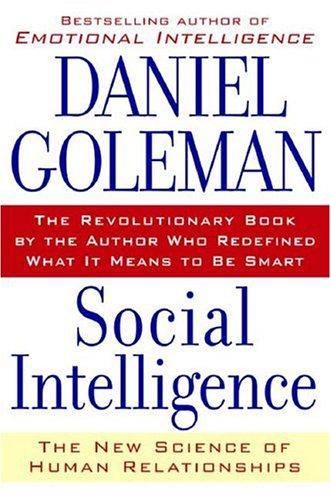
Talk to Social Intelligence: The New Science of Human Relationships like its author wrote you back.
Get the ideas that fit your life — not generic summaries.
- Chat with the book
- Audiobook-style main ideas
- Adapts to your life and goals
- Helps you take action
Social Intelligence: The New Science of Human Relationships, in detail
Daniel Goleman's follow-up to Emotional Intelligence shifts focus from the inner world to the social. Where emotional intelligence is about managing your own feelings, social intelligence is about what happens in the space between people — the mostly unconscious processes by which we read, influence, and are shaped by others. Goleman draws heavily on the then-emerging field of social neuroscience, particularly research on mirror neurons and the brain's dedicated social circuits, to argue that our brains are wired for connection in ways that are more fundamental than previously understood.
The book's central claim is that relationships are not merely psychological but biological. Sustained toxic relationships produce measurable changes in stress hormones, immune function, and brain structure. Sustained nurturing relationships do the opposite. The people we spend time with literally reshape us physiologically, and the effects accumulate over a lifetime. Goleman calls this "interpersonal neurobiology."
The first half covers the science: mirror neurons that allow us to feel what others feel, the low road and high road of emotional processing, the difference between empathy and projection, and how social signals like tone of voice and eye contact bypass conscious cognition to trigger immediate physiological responses. The second half applies this to relationships — parenting, teaching, leadership, and intimate partnerships — arguing that social intelligence can be developed deliberately.
Goleman's writing is fluid and his examples are vivid, but critics have noted that the book's reliance on mirror neuron research was somewhat ahead of the evidence. Subsequent replication issues in that literature mean some specific claims require caution. The broader argument about social connection and health, however, is well-supported by independent research. The book is most useful as a framework for thinking about how other people affect us and how we affect them — less as a neuroscience textbook and more as an invitation to take the relational dimension of life seriously.
The big ideas
- 1.
The brain has dedicated social circuits, including regions involved in reading faces, voices, and intentions, that operate largely beneath conscious awareness and respond faster than deliberate thought.
- 2.
Mirror neurons allow us to simulate the emotional states of others in our own nervous systems. Empathy is not just a cognitive judgment but a felt, bodily resonance.
- 3.
Emotional contagion is real and largely unconscious. Being around anxious, hostile, or depressed people shifts your own neurochemistry in measurable ways, regardless of whether you are aware of it.
