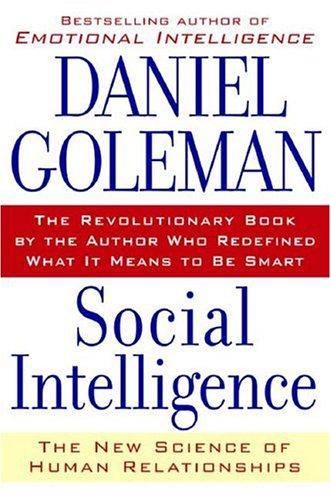
Social Intelligence: The New Science of Human Relationships by Daniel Goleman is a 2006 psychology book about social neuroscience, empathy, relationships. The brain has dedicated social circuits, including regions involved in reading faces, voices, and intentions, that operate largely beneath conscious awareness and respond faster than deliberate thought.
Summary
Daniel Goleman's follow-up to Emotional Intelligence shifts focus from the inner world to the social. Where emotional intelligence is about managing your own feelings, social intelligence is about what happens in the space between people — the mostly unconscious processes by which we read, influence, and are shaped by others. Goleman draws heavily on the then-emerging field of social neuroscience, particularly research on mirror neurons and the brain's dedicated social circuits, to argue that our brains are wired for connection in ways that are more fundamental than previously understood.
The book's central claim is that relationships are not merely psychological but biological. Sustained toxic relationships produce measurable changes in stress hormones, immune function, and brain structure. Sustained nurturing relationships do the opposite. The people we spend time with literally reshape us physiologically, and the effects accumulate over a lifetime. Goleman calls this "interpersonal neurobiology."
The first half covers the science: mirror neurons that allow us to feel what others feel, the low road and high road of emotional processing, the difference between empathy and projection, and how social signals like tone of voice and eye contact bypass conscious cognition to trigger immediate physiological responses. The second half applies this to relationships — parenting, teaching, leadership, and intimate partnerships — arguing that social intelligence can be developed deliberately.
Goleman's writing is fluid and his examples are vivid, but critics have noted that the book's reliance on mirror neuron research was somewhat ahead of the evidence. Subsequent replication issues in that literature mean some specific claims require caution. The broader argument about social connection and health, however, is well-supported by independent research. The book is most useful as a framework for thinking about how other people affect us and how we affect them — less as a neuroscience textbook and more as an invitation to take the relational dimension of life seriously.
Talk to Social Intelligence: The New Science of Human Relationships like its author wrote you back.
Get the ideas that fit your life — not generic summaries.
- Chat with the book
- Audiobook-style main ideas
- Adapts to your life and goals
- Helps you take action
Key takeaways
- 1.
The brain has dedicated social circuits, including regions involved in reading faces, voices, and intentions, that operate largely beneath conscious awareness and respond faster than deliberate thought.
- 2.
Mirror neurons allow us to simulate the emotional states of others in our own nervous systems. Empathy is not just a cognitive judgment but a felt, bodily resonance.
- 3.
Emotional contagion is real and largely unconscious. Being around anxious, hostile, or depressed people shifts your own neurochemistry in measurable ways, regardless of whether you are aware of it.
- 4.
Toxic relationships cause biological harm. Chronic exposure to hostile or dismissive relationships elevates cortisol, suppresses immune function, and can alter brain structure over time.
- 5.
The quality of early attachment shapes the social brain. Children with secure attachments develop better capacities for emotional regulation and reading others than those with insecure early relationships.
- 6.
Social intelligence can be developed. Skills like accurate empathy, listening without projection, and managing your own emotional contagion on others can all be practiced deliberately.
- 7.
Leaders have outsized emotional influence on their groups. The boss's mood spreads through a team faster and more thoroughly than any formal communication, and the neurological mechanism is the same as any other social contagion.
- 8.
Loneliness is a health risk comparable to smoking. Social isolation produces a biological stress response that, when chronic, accelerates aging and increases mortality risk.
Discussion questions
Use these on your own, with a book club, or as chat starters in Superbook. Book club version, ready to copy or print →
- 1.
Goleman argues that other people literally reshape our biology over time. Who in your life has had that kind of effect on you — in either direction — and were you aware of it at the time?
- 2.
The book distinguishes accurate empathy from projection. Think of a recent conflict: were you feeling what the other person actually felt, or were you projecting what you would feel in their situation?
- 3.
Emotional contagion suggests we absorb the emotional states of people around us without choosing to. How has your mood been systematically affected by someone in your environment whose emotional state you didn't consciously register as influential?
- 4.
If relationships are as biologically consequential as Goleman argues, how would you prioritize differently the relationships you currently maintain, tolerate, or avoid?
- 5.
Goleman draws on mirror neuron research to explain empathy, but that research has since been disputed in some of its claims. How much does the scientific credibility of a book's neuroscience affect how much you trust its broader message?
- 6.
The book argues that leaders are emotional radiators whose moods spread rapidly through groups. When have you experienced this effect — either as a leader or as someone in a leader's orbit?
- 7.
What does genuine listening look like, as opposed to waiting to speak while tracking the emotional content of what's being said? How often do you actually do it?
- 8.
Goleman suggests social intelligence can be developed deliberately. What specific practice would make the biggest difference in how you show up in relationships?
- 9.
The book describes a high road and low road of emotional processing — slow deliberate and fast automatic. When does your low road override your better judgment in social situations?
- 10.
Loneliness as a biological stressor is a theme Goleman returns to throughout. Where in your life, if anywhere, does loneliness operate at a low level that you don't fully acknowledge?
- 11.
How did the relationships you observed between your parents or caregivers shape your own model of what relationships are supposed to feel like?
- 12.
Goleman claims that parental attunement physically shapes children's nervous systems. What does that imply about how we should prioritize the quality of presence versus the quantity of time in caregiving?
Themes
Frequently asked questions
-
Is Social Intelligence different from Emotional Intelligence?
Yes. Emotional Intelligence focuses on managing your own emotions; Social Intelligence focuses on the two-way neurological processes between people — how we read each other, affect each other, and are biologically shaped by our relationships. The two books complement each other but cover different territory.
-
Is the neuroscience in Social Intelligence still accurate?
Some of it, particularly the mirror neuron sections, has been disputed or refined since 2006. The broader claims about social connection and health are supported by independent research, but specific neuroscientific details should be taken as suggestive rather than settled.
-
How long does it take to read Social Intelligence?
About six to seven hours. The book is denser than Emotional Intelligence and rewards slower reading in the science-heavy first half. The second half on applications is more accessible.
-
Who should read Social Intelligence?
Anyone in leadership, teaching, therapy, or caregiving will find the practical implications directly useful. General readers who want to understand how relationships affect health and brain function will also benefit, provided they read the neuroscience sections with appropriate skepticism.
-
What is the most important idea in Social Intelligence?
That relationships are not just psychological but biological — that the people we spend time with reshape our stress hormones, immune systems, and nervous systems over time. This makes the quality of our social environment a health decision, not just a preference.
Similar books
Emotional Intelligence
Daniel Goleman
Behave: The Biology of Humans at Our Best and Worst
Robert M. Sapolsky

The Social Animal
Elliot Aronson
Social: Why Our Brains Are Wired to Connect
Matthew D. Lieberman
