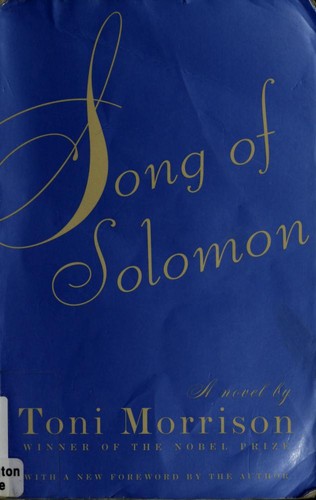
Talk to Song of Solomon like its author wrote you back.
Get the ideas that fit your life — not generic summaries.
- Chat with the book
- Audiobook-style main ideas
- Adapts to your life and goals
- Helps you take action
What it argues
Song of Solomon follows Macon Dead III — called Milkman — from his birth in 1930s Michigan through his eventual journey southward in search of family gold that turns into a search for something far older: his own origins and name. Milkman grows up insulated from struggle by his father's property-obsessed ambition and his mother's smothering, but surrounded by people whose lives have been shaped by racial violence and dispossession in ways he cannot yet read.
The novel's engine is inheritance — not just of money but of story, name, and wound. Macon Dead Sr. was shot off his own land by white men who wanted it. Pilate, Milkman's aunt and the novel's moral center, carries a geography of grief and rootedness inside her that Milkman can barely comprehend. Guitar, Milkman's best friend, moves toward a kind of revolutionary violence that the novel neither endorses nor simply condemns. What Milkman lacks is any sense that his own history is worth knowing — and the novel is the story of what it costs him to discover otherwise.
What it gets right
- 1.
Identity in the novel isn't given — it's recovered. Milkman's journey south is literally a journey toward knowing his own name, and the novel treats this as the only journey that matters.
- 2.
Pilate is the novel's moral north star: a woman who lives entirely outside conventional Black middle-class aspiration and carries the dead with her without being destroyed by them.
- 3.
The flying African myth frames the entire book. Flight is freedom, but Morrison asks: what is left behind when someone flies away? Ryna's cry, Pilate's rootedness, are the answer.
What it covers
Who wrote it
Toni Morrison (1931–2019) was an American novelist, editor, and professor widely regarded as one of the greatest writers of the twentieth century. She won the Nobel Prize in Literature in 1993 and the Pulitzer Prize for Beloved. Song of Solomon, published in 1977, won the National Book Critics Circle Award and was her first major bestseller. Her other novels include The Bluest Eye, Sula, Tar Baby, Jazz, and Paradise. She taught creative writing at Princeton for nearly two decades and was also an influential editor at Random House.
