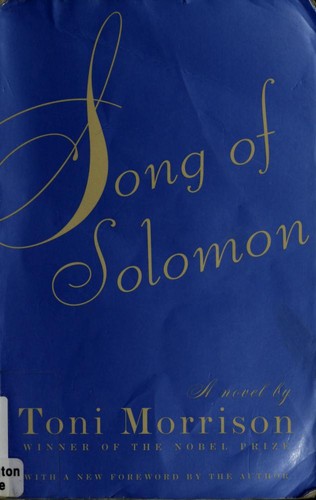
Song of Solomon by Toni Morrison is a 1977 literary fiction book about identity and self-discovery, race and belonging, family and mythology. Identity in the novel isn't given — it's recovered. Milkman's journey south is literally a journey toward knowing his own name, and the novel treats this as the only journey that matters.
Summary
Song of Solomon follows Macon Dead III — called Milkman — from his birth in 1930s Michigan through his eventual journey southward in search of family gold that turns into a search for something far older: his own origins and name. Milkman grows up insulated from struggle by his father's property-obsessed ambition and his mother's smothering, but surrounded by people whose lives have been shaped by racial violence and dispossession in ways he cannot yet read.
The novel's engine is inheritance — not just of money but of story, name, and wound. Macon Dead Sr. was shot off his own land by white men who wanted it. Pilate, Milkman's aunt and the novel's moral center, carries a geography of grief and rootedness inside her that Milkman can barely comprehend. Guitar, Milkman's best friend, moves toward a kind of revolutionary violence that the novel neither endorses nor simply condemns. What Milkman lacks is any sense that his own history is worth knowing — and the novel is the story of what it costs him to discover otherwise.
Morrison weaves in myth and folk legend, most importantly the legend of the flying Africans — enslaved people who escaped by taking to the air. This magical-realist strand is handled with extraordinary tact; the flights operate simultaneously as folk tale, spiritual inheritance, and psychological truth. The prose is looser and more joyful than Beloved, shot through with humor and music, particularly in the scenes centered on Pilate, who is one of the great characters in American fiction.
Song of Solomon is the most accessible of Morrison's major novels and the one that won the National Book Critics Circle Award and the broadest readership in her lifetime. Readers who find Beloved's density daunting often find this the better entry point. The mythic resonances and the dense family genealogy require some patience in the first third, but the novel earns every strand it sets down.
Talk to Song of Solomon like its author wrote you back.
Get the ideas that fit your life — not generic summaries.
- Chat with the book
- Audiobook-style main ideas
- Adapts to your life and goals
- Helps you take action
Key takeaways
- 1.
Identity in the novel isn't given — it's recovered. Milkman's journey south is literally a journey toward knowing his own name, and the novel treats this as the only journey that matters.
- 2.
Pilate is the novel's moral north star: a woman who lives entirely outside conventional Black middle-class aspiration and carries the dead with her without being destroyed by them.
- 3.
The flying African myth frames the entire book. Flight is freedom, but Morrison asks: what is left behind when someone flies away? Ryna's cry, Pilate's rootedness, are the answer.
- 4.
Guitar's radicalization is presented as a comprehensible response to racial terror — the novel refuses to make him simply a villain, which makes his arc harder and more honest.
- 5.
Macon Dead's obsession with property is a response to his father's murder, but it has calcified into something that kills his family's inner life. Property as both trauma response and corruption is a recurring Morrison tension.
- 6.
The names in the novel — Macon Dead, Pilate, First Corinthians — are loaded with meaning about identity imposed, inherited, and chosen.
- 7.
Milkman's passivity and self-absorption are treated not as personal failings but as symptoms of insulation from history. Connecting to history transforms him, but the transformation has a cost.
- 8.
The community of women — Pilate, Reba, Hagar — represents an alternative mode of survival built on love and oral tradition rather than accumulation.
Discussion questions
Use these on your own, with a book club, or as chat starters in Superbook. Book club version, ready to copy or print →
- 1.
Pilate carries a brass box with her father's bones and 'his name, written on a piece of paper.' What is Morrison saying about the relationship between names, ancestry, and grief?
- 2.
Guitar argues that every Black death demands a proportionate act of violence. Is the novel sympathetic to his logic, even if not to his methods?
- 3.
Milkman is presented as passive and oblivious for most of the novel. Is his transformation in the South earned, or does it feel abrupt?
- 4.
The flying African myth runs through the novel as both magic and metaphor. What does flight cost? Who gets left behind, and what does the novel make of that?
- 5.
Hagar's obsession with Milkman destroys her. Does the novel treat this as tragedy, as critique, or as something more complicated?
- 6.
Macon Dead and Pilate are siblings shaped by the same trauma but live completely differently. Which of them seems freer to you, and why?
- 7.
Morrison's men are often morally more compromised than her women. Do you find that a pattern, and if so, what is she doing with it?
- 8.
The novel's title comes from the biblical Song of Solomon but doesn't quote or directly engage it much. What is Morrison doing with that title?
- 9.
Compared to Beloved, which tells a story of a woman who cannot escape the past, Song of Solomon tells a story of a man who cannot find his past. Which feels more urgent to you?
- 10.
What does the ending — Milkman in the air — mean? Is it triumphant, fatal, or both?
- 11.
The first third of the novel is dense with family backstory and can feel slow. Did you almost quit? What kept you reading?
- 12.
Who in your own life is most like Pilate — someone who carries their history without being consumed by it?
Themes
Frequently asked questions
-
Is Song of Solomon a good starting point for Toni Morrison?
Yes, it is probably the most accessible of her major novels. The mythic structure, the vivid characters (especially Pilate), and the more linear plot make it easier to enter than Beloved. Most readers find it an emotionally rewarding experience even before they unpack all its layers.
-
What is Song of Solomon about, without spoilers?
A Black man in mid-twentieth-century America goes on a journey south to find family treasure and instead discovers his own history and ancestry. It is a novel about identity, myth, and what it means to know where you come from.
-
Is Song of Solomon hard to read?
The first third is dense — Morrison front-loads family genealogy and backstory. The prose is more accessible than Beloved but still requires close attention. By the midpoint most readers find themselves fully inside the novel's world.
-
Why is Pilate considered one of the great characters in American fiction?
She has no navel (born after her mother died), lives outside society, makes wine, carries her dead father in a box, and is utterly at peace with all of it. She represents an alternative mode of Black womanhood — rooted, ungovernable, and deeply loving — that Morrison uses as the novel's moral compass.
-
Who shouldn't read Song of Solomon?
Readers who need a protagonist they can root for unambiguously may find Milkman frustrating for much of the book. The novel rewards patience and a tolerance for moral ambiguity.
Similar books
Between the World and Me
Ta-Nehisi Coates
Stamped from the Beginning: The Definitive History of Racist Ideas in America
Ibram X. Kendi
The Alchemist
Paulo Coelho
A Heartbreaking Work of Staggering Genius
Dave Eggers
