Talk to Sophie's World like its author wrote you back.
Get the ideas that fit your life — not generic summaries.
- Chat with the book
- Audiobook-style main ideas
- Adapts to your life and goals
- Helps you take action
What it argues
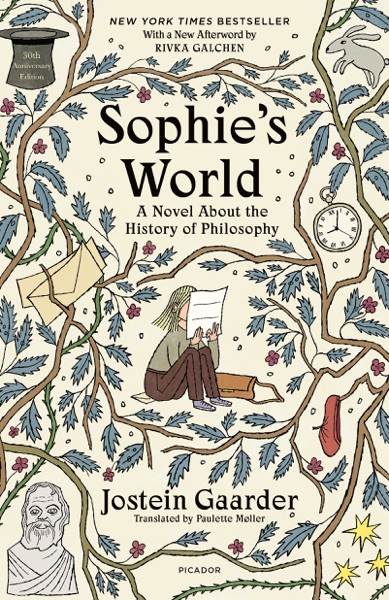
Sophie's World is Jostein Gaarder's novel about a fourteen-year-old Norwegian girl who begins receiving anonymous philosophy lessons — first as mysterious letters, then from a philosopher named Alberto Knox — that take her through the entire history of Western philosophy from the pre-Socratics to the present day. Published in Norway in 1991 and translated into dozens of languages, it became one of the best-selling Norwegian novels ever written and introduced philosophy to millions of readers who had never encountered it formally.
Gaarder's method is unusual and effective: the philosophical content is delivered through dialogue and mystery rather than lecture. Sophie's curiosity is the reader's guide, and her questions — naïve in exactly the right way — push Alberto to explain ideas in language that assumes no prior knowledge. The history of philosophy unfolds as a story, with Socrates, Plato, Aristotle, Descartes, Hume, Kant, Hegel, Marx, Darwin, Freud, and Sartre each appearing in sequence as the correspondence develops. The novel format allows Gaarder to dramatize the stakes of philosophical questions rather than treating them as academic exercises.
What it gets right
- 1.
Philosophy is not a set of answers but a discipline of questions. Every major Western philosopher begins by questioning what was taken for granted before them.
- 2.
The history of philosophy shows a coherent development: later thinkers respond to earlier ones, and understanding any philosopher well requires knowing who they were arguing with.
- 3.
The ancient Greeks asked what things are fundamentally made of and how we can know anything. Two and a half millennia of Western philosophy is largely an elaboration of those two questions.
What it covers
Who wrote it
Jostein Gaarder is a Norwegian author and former philosophy teacher born in 1952. He taught philosophy and literature at a gymnasium in Bergen before publishing Sophie's World in 1991. The novel was translated into more than sixty languages and sold over forty million copies, making Gaarder one of the best-selling Norwegian authors in history. He has written numerous other novels and short story collections, many of which engage with philosophical themes, including The Christmas Mystery, Through a Glass, Darkly, and Maya. He is also a co-founder of the Sophie Prize, an environmental award established in 1997.
