Talk to Sophie's World like its author wrote you back.
Get the ideas that fit your life — not generic summaries.
- Chat with the book
- Audiobook-style main ideas
- Adapts to your life and goals
- Helps you take action
Sophie's World, in detail
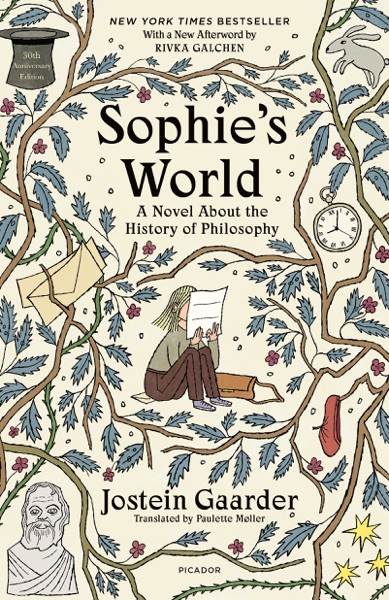
Sophie's World is Jostein Gaarder's novel about a fourteen-year-old Norwegian girl who begins receiving anonymous philosophy lessons — first as mysterious letters, then from a philosopher named Alberto Knox — that take her through the entire history of Western philosophy from the pre-Socratics to the present day. Published in Norway in 1991 and translated into dozens of languages, it became one of the best-selling Norwegian novels ever written and introduced philosophy to millions of readers who had never encountered it formally.
Gaarder's method is unusual and effective: the philosophical content is delivered through dialogue and mystery rather than lecture. Sophie's curiosity is the reader's guide, and her questions — naïve in exactly the right way — push Alberto to explain ideas in language that assumes no prior knowledge. The history of philosophy unfolds as a story, with Socrates, Plato, Aristotle, Descartes, Hume, Kant, Hegel, Marx, Darwin, Freud, and Sartre each appearing in sequence as the correspondence develops. The novel format allows Gaarder to dramatize the stakes of philosophical questions rather than treating them as academic exercises.
Midway through the book, a second narrative layer emerges: a girl named Hilde begins finding a birthday gift intended for her from her philosopher father. The relationship between Sophie's world and Hilde's becomes increasingly strange, and the final third of the novel is an extended meditation on consciousness, fiction, existence, and the relationship between the observer and the observed. This meta-narrative is either the book's most original contribution or its most confusing section, depending on the reader.
Sophie's World is not a substitute for reading philosophy, and it covers some thinkers shallowly. Sartre's existentialism gets fewer pages than it deserves; the analytic tradition barely appears. Gaarder's sympathies are with the European continental tradition. But as an introduction — as a book that makes you want to read Plato or understand what Kant was arguing — it is unusually good. The combination of genuine philosophical content with narrative momentum is rare, and the questions the book raises about the nature of reality and the place of the individual in history linger long after the plot is resolved.
The big ideas
- 1.
Philosophy is not a set of answers but a discipline of questions. Every major Western philosopher begins by questioning what was taken for granted before them.
- 2.
The history of philosophy shows a coherent development: later thinkers respond to earlier ones, and understanding any philosopher well requires knowing who they were arguing with.
- 3.
The ancient Greeks asked what things are fundamentally made of and how we can know anything. Two and a half millennia of Western philosophy is largely an elaboration of those two questions.
