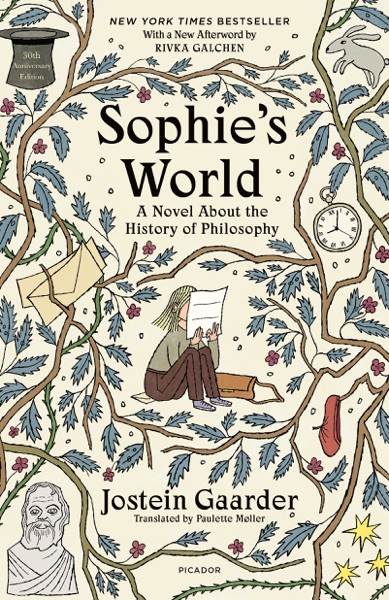
Sophie's World by Jostein Gaarder is a 1991 philosophy book about history of philosophy, identity and consciousness, coming of age. Philosophy is not a set of answers but a discipline of questions. Every major Western philosopher begins by questioning what was taken for granted before them.
Summary
Sophie's World is Jostein Gaarder's novel about a fourteen-year-old Norwegian girl who begins receiving anonymous philosophy lessons — first as mysterious letters, then from a philosopher named Alberto Knox — that take her through the entire history of Western philosophy from the pre-Socratics to the present day. Published in Norway in 1991 and translated into dozens of languages, it became one of the best-selling Norwegian novels ever written and introduced philosophy to millions of readers who had never encountered it formally.
Gaarder's method is unusual and effective: the philosophical content is delivered through dialogue and mystery rather than lecture. Sophie's curiosity is the reader's guide, and her questions — naïve in exactly the right way — push Alberto to explain ideas in language that assumes no prior knowledge. The history of philosophy unfolds as a story, with Socrates, Plato, Aristotle, Descartes, Hume, Kant, Hegel, Marx, Darwin, Freud, and Sartre each appearing in sequence as the correspondence develops. The novel format allows Gaarder to dramatize the stakes of philosophical questions rather than treating them as academic exercises.
Midway through the book, a second narrative layer emerges: a girl named Hilde begins finding a birthday gift intended for her from her philosopher father. The relationship between Sophie's world and Hilde's becomes increasingly strange, and the final third of the novel is an extended meditation on consciousness, fiction, existence, and the relationship between the observer and the observed. This meta-narrative is either the book's most original contribution or its most confusing section, depending on the reader.
Sophie's World is not a substitute for reading philosophy, and it covers some thinkers shallowly. Sartre's existentialism gets fewer pages than it deserves; the analytic tradition barely appears. Gaarder's sympathies are with the European continental tradition. But as an introduction — as a book that makes you want to read Plato or understand what Kant was arguing — it is unusually good. The combination of genuine philosophical content with narrative momentum is rare, and the questions the book raises about the nature of reality and the place of the individual in history linger long after the plot is resolved.
Talk to Sophie's World like its author wrote you back.
Get the ideas that fit your life — not generic summaries.
- Chat with the book
- Audiobook-style main ideas
- Adapts to your life and goals
- Helps you take action
Key takeaways
- 1.
Philosophy is not a set of answers but a discipline of questions. Every major Western philosopher begins by questioning what was taken for granted before them.
- 2.
The history of philosophy shows a coherent development: later thinkers respond to earlier ones, and understanding any philosopher well requires knowing who they were arguing with.
- 3.
The ancient Greeks asked what things are fundamentally made of and how we can know anything. Two and a half millennia of Western philosophy is largely an elaboration of those two questions.
- 4.
Descartes' method of systematic doubt — his attempt to find a bedrock certainty on which to rebuild knowledge — is a founding gesture of modern philosophy and of scientific rationalism.
- 5.
Kant's insight that the mind actively structures experience rather than passively receiving it was, in his own estimation, a Copernican revolution in philosophy.
- 6.
The meta-narrative in Sophie's World raises the question of what it would mean to be a fictional character who becomes aware of being fictional — and whether that situation is entirely different from the human one.
- 7.
Darwin's theory changed not just biology but philosophy: it replaced static essence with development and contingency, affecting how we think about progress, identity, and purpose.
- 8.
Sartre's existentialism — existence precedes essence — argues that humans have no fixed nature, only the choices they make. The freedom this implies is also the responsibility.
Discussion questions
Use these on your own, with a book club, or as chat starters in Superbook. Book club version, ready to copy or print →
- 1.
Gaarder chooses to teach philosophy through fiction rather than exposition. What does that format allow that a textbook doesn't, and what does it sacrifice?
- 2.
Which philosopher in Sophie's journey did you find most compelling or most alien, and what does your reaction say about your own assumptions?
- 3.
The meta-narrative asks: if Sophie is a fictional character who becomes aware of her fictional status, does she have a different kind of consciousness than one who doesn't? How does that apply to humans?
- 4.
Descartes concluded that the one thing he couldn't doubt was that he was thinking. Is that still a satisfying answer, or does it simply push the problem back a step?
- 5.
Kant argued that we can never know the thing-in-itself (the Ding an sich) — only the world as structured by our perception. Does that feel like a discovery or a defeat?
- 6.
The book covers enormous philosophical ground at speed. Where did you feel the presentation was too compressed to be useful?
- 7.
Gaarder's sympathies seem to lie with the continental European tradition. What gets left out by that emphasis?
- 8.
The novel form requires a protagonist with genuine curiosity. Does Sophie feel like a real person to you, or a device? Does it matter?
- 9.
Marx, Darwin, and Freud appear near the end as demolishers of comfortable assumptions about human nature and history. Which of the three still feels most unsettled in current culture?
- 10.
The book ends with a scene that deliberately collapses the boundary between fiction and reality. Did it work for you, or did the narrative trick undermine the philosophical substance?
- 11.
Sophie's World introduced many readers to philosophy who never pursued it further. What would you say to someone who has read this book and wants to go deeper into any one philosopher it covers?
- 12.
Gaarder wrote this primarily for Norwegian teenagers. Does it feel like that? What assumptions about the reader are visible in the text?
Themes
Frequently asked questions
-
What is Sophie's World about?
A Norwegian teenager who receives anonymous philosophy lessons covering the entire history of Western thought, from the pre-Socratics through Sartre, embedded in a mystery novel that gradually becomes a meditation on the nature of reality, consciousness, and fiction.
-
Is Sophie's World a good introduction to philosophy?
Yes, as an introduction. It creates genuine interest in philosophical questions and gives enough context to approach actual primary texts. It is not a substitute for reading the philosophers themselves — coverage is uneven and some thinkers are treated superficially — but as a gateway it is unusually effective.
-
How long is Sophie's World?
Around 500 pages in most editions. At average reading pace it takes roughly ten hours. The philosophical sections require slower reading than the narrative sections, but the mystery plot provides enough momentum to keep most readers going.
-
Is Sophie's World a novel or a philosophy textbook?
Both, awkwardly and successfully at the same time. The philosophical content is real and reasonably accurate; the novel structure provides narrative momentum and makes the abstract material emotionally engaging. Neither the philosophy nor the fiction is as developed as it would be in a pure example of either genre.
-
What age is Sophie's World appropriate for?
Gaarder wrote it for Norwegian teenagers, and it works well for motivated readers from about thirteen or fourteen upward. It's equally readable for adults with no philosophy background who want a narrative entry point to the tradition.