Talk to Spillover like its author wrote you back.
Get the ideas that fit your life — not generic summaries.
- Chat with the book
- Audiobook-style main ideas
- Adapts to your life and goals
- Helps you take action
What it argues
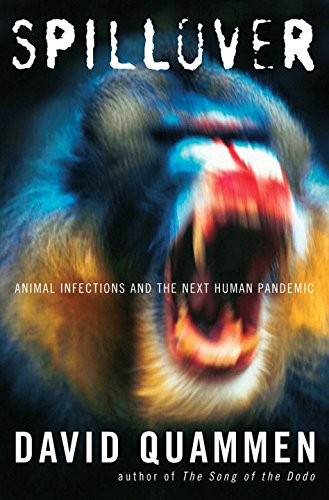
Spillover is David Quammen's exhaustive investigation into zoonotic disease — illness that jumps from animals to humans — and the ecological and evolutionary logic behind why such spillover events happen. Published in 2012, it reads with uncomfortable prescience given what followed in the next decade. Quammen spent years traveling to outbreak sites and interviewing field ecologists, epidemiologists, and virologists, and the book is unusually grounded in primary fieldwork rather than secondary synthesis.
Quammen covers a wide range of pathogens: Hendra virus, Ebola, Marburg, SARS, Nipah, Q fever, Lyme disease, and the deep history of HIV. Each chapter follows a different spillover, tracing it from the animal reservoir through the contact event that introduced it to humans, through the epidemiological response, and into the broader question of why these events are becoming more frequent. The answer is consistent across cases: habitat destruction brings humans into contact with reservoir species; larger, denser human populations give viruses more hosts to chain through; global travel compresses the geographic spread.
What it gets right
- 1.
Zoonotic spillover — pathogen transmission from animals to humans — is the origin of most new infectious diseases, including HIV, Ebola, SARS, and likely COVID-19.
- 2.
Bats are disproportionate reservoir hosts because their immune systems tolerate viral diversity that would kill other mammals, and because they roost in large colonial groups.
- 3.
Habitat destruction is the primary driver of increased spillover events: it forces reservoir species into contact with human populations that have no immunity.
What it covers
Who wrote it
David Quammen is an American science journalist and the author of more than a dozen books, including The Song of the Dodo, The Reluctant Mr. Darwin, and Tangled Tree. He has written for National Geographic, Rolling Stone, and The New York Times. He spent years in the field researching Spillover, visiting outbreak sites across Africa, Asia, and Australia. His work is known for combining rigorous scientific reporting with literary writing that slows down to examine specific events and people rather than summarizing from above.
