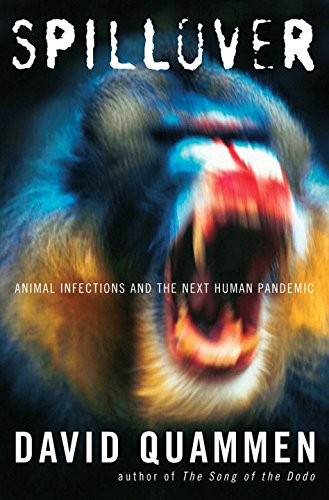
Talk to Spillover like its author wrote you back.
Get the ideas that fit your life — not generic summaries.
- Chat with the book
- Audiobook-style main ideas
- Adapts to your life and goals
- Helps you take action
Spillover, in detail
Spillover is David Quammen's exhaustive investigation into zoonotic disease — illness that jumps from animals to humans — and the ecological and evolutionary logic behind why such spillover events happen. Published in 2012, it reads with uncomfortable prescience given what followed in the next decade. Quammen spent years traveling to outbreak sites and interviewing field ecologists, epidemiologists, and virologists, and the book is unusually grounded in primary fieldwork rather than secondary synthesis.
Quammen covers a wide range of pathogens: Hendra virus, Ebola, Marburg, SARS, Nipah, Q fever, Lyme disease, and the deep history of HIV. Each chapter follows a different spillover, tracing it from the animal reservoir through the contact event that introduced it to humans, through the epidemiological response, and into the broader question of why these events are becoming more frequent. The answer is consistent across cases: habitat destruction brings humans into contact with reservoir species; larger, denser human populations give viruses more hosts to chain through; global travel compresses the geographic spread.
One of Spillover's most valuable contributions is the concept of the reservoir host — the animal species that carries a pathogen without becoming ill, acting as a long-term reservoir from which spillover can occur. Bats are central characters throughout the book. The evidence that bats carry an unusually high diversity of potentially dangerous viruses, and that they do so because of specific features of their immune system and their roosting behavior, is one of the most important findings in contemporary epidemiology, and Quammen explains it better than almost any other popular treatment.
The book is long and deliberately so. Quammen is not interested in a quick argument; he's building a case through accumulation. Some readers will find the pace slow. But the reward is a much richer understanding of why pandemic risk is structural rather than accidental — why, as he puts it, the Next Big One is not a question of if but of when. Written eight years before COVID-19, Spillover is the best preparation most readers could have had.
The big ideas
- 1.
Zoonotic spillover — pathogen transmission from animals to humans — is the origin of most new infectious diseases, including HIV, Ebola, SARS, and likely COVID-19.
- 2.
Bats are disproportionate reservoir hosts because their immune systems tolerate viral diversity that would kill other mammals, and because they roost in large colonial groups.
- 3.
Habitat destruction is the primary driver of increased spillover events: it forces reservoir species into contact with human populations that have no immunity.
