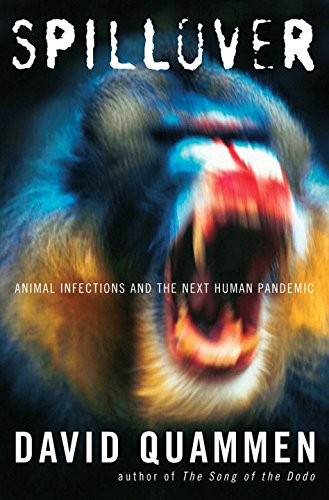
Spillover by David Quammen is a 2012 science book about zoonotic disease, ecology, epidemics. Zoonotic spillover — pathogen transmission from animals to humans — is the origin of most new infectious diseases, including HIV, Ebola, SARS, and likely COVID-19.
Summary
Spillover is David Quammen's exhaustive investigation into zoonotic disease — illness that jumps from animals to humans — and the ecological and evolutionary logic behind why such spillover events happen. Published in 2012, it reads with uncomfortable prescience given what followed in the next decade. Quammen spent years traveling to outbreak sites and interviewing field ecologists, epidemiologists, and virologists, and the book is unusually grounded in primary fieldwork rather than secondary synthesis.
Quammen covers a wide range of pathogens: Hendra virus, Ebola, Marburg, SARS, Nipah, Q fever, Lyme disease, and the deep history of HIV. Each chapter follows a different spillover, tracing it from the animal reservoir through the contact event that introduced it to humans, through the epidemiological response, and into the broader question of why these events are becoming more frequent. The answer is consistent across cases: habitat destruction brings humans into contact with reservoir species; larger, denser human populations give viruses more hosts to chain through; global travel compresses the geographic spread.
One of Spillover's most valuable contributions is the concept of the reservoir host — the animal species that carries a pathogen without becoming ill, acting as a long-term reservoir from which spillover can occur. Bats are central characters throughout the book. The evidence that bats carry an unusually high diversity of potentially dangerous viruses, and that they do so because of specific features of their immune system and their roosting behavior, is one of the most important findings in contemporary epidemiology, and Quammen explains it better than almost any other popular treatment.
The book is long and deliberately so. Quammen is not interested in a quick argument; he's building a case through accumulation. Some readers will find the pace slow. But the reward is a much richer understanding of why pandemic risk is structural rather than accidental — why, as he puts it, the Next Big One is not a question of if but of when. Written eight years before COVID-19, Spillover is the best preparation most readers could have had.
Talk to Spillover like its author wrote you back.
Get the ideas that fit your life — not generic summaries.
- Chat with the book
- Audiobook-style main ideas
- Adapts to your life and goals
- Helps you take action
Key takeaways
- 1.
Zoonotic spillover — pathogen transmission from animals to humans — is the origin of most new infectious diseases, including HIV, Ebola, SARS, and likely COVID-19.
- 2.
Bats are disproportionate reservoir hosts because their immune systems tolerate viral diversity that would kill other mammals, and because they roost in large colonial groups.
- 3.
Habitat destruction is the primary driver of increased spillover events: it forces reservoir species into contact with human populations that have no immunity.
- 4.
The reservoir host of Ebola remains unconfirmed decades after its discovery, illustrating how difficult it is to find a pathogen's origin even with sustained scientific effort.
- 5.
Pandemic potential is partly a function of the R₀ value — how many people each infected person infects — and of the incubation period relative to the infectious period.
- 6.
HIV originated from a single spillover event, probably a human hunter butchering a chimpanzee in Central Africa, and then spread slowly for decades before anyone noticed.
- 7.
The Next Big One is an epidemiological near-certainty: the structural conditions that produce spillover events are intensifying, not abating.
- 8.
Field epidemiology is messy and dangerous work conducted mostly by people the public never hears about, often in remote locations without adequate resources.
Discussion questions
Use these on your own, with a book club, or as chat starters in Superbook. Book club version, ready to copy or print →
- 1.
Quammen argues that pandemic risk is structural — driven by habitat destruction and population density — rather than random. Does that framing change how you think about pandemic preparedness policy?
- 2.
The bat chapters make a strong case that specific ecological features of bats make them uniquely dangerous reservoir hosts. Were you aware of this before reading? What surprised you most?
- 3.
Quammen spent years in the field for this book. What does primary fieldwork add to science journalism that secondary synthesis can't provide?
- 4.
How do you read Spillover differently knowing about COVID-19? Does its prescience make it more or less useful as a guide to understanding the present?
- 5.
The book traces HIV to a single spillover event, probably a single hunter. How do you hold together that contingency — one moment — with the structural forces that made the pandemic possible?
- 6.
Quammen treats the Next Big One as a near-certainty. Does that certainty change anything about how you think individual people should respond versus how governments should respond?
- 7.
The reservoir host problem — finding where a virus hides between outbreaks — has never been solved for Ebola. What does that say about the limits of epidemiological knowledge?
- 8.
Quammen writes about scientists who spend careers studying viruses in bats in remote forests. What draws people to that kind of work?
- 9.
Which spillover event in the book did you find most alarming? Which was least surprising?
- 10.
The book was published in 2012. If Quammen were revising it today, what new cases would he add and how do you think his argument would change?
- 11.
Habitat destruction is the structural driver Quammen emphasizes. But that destruction is driven by poverty and development pressure in the same regions where reservoir species live. How do you weigh that tradeoff?
- 12.
Spillover is dense and long. What would you have cut, and what does the length give you that a shorter book couldn't?
Themes
Frequently asked questions
-
Is Spillover worth reading after COVID-19?
Particularly worth reading after COVID-19. The book explains exactly why that pandemic happened and why the conditions that produced it are becoming more common, not less. Reading it gives a structural framework that headlines rarely provide.
-
How long is Spillover?
Roughly 500 pages, which at average pace is about eight to nine hours. It's a long book and Quammen intends it to be: the argument builds through accumulation across many cases rather than from a single thesis.
-
What is the main idea of Spillover?
That the pathogens most likely to cause the next pandemic are zoonotic — they come from animals — that the ecological conditions producing spillover events are worsening, and that understanding those conditions is the best preparation for what's coming.
-
Who should read Spillover?
Anyone who wants to understand pandemic risk from first principles rather than from media coverage. Scientists, public health professionals, and serious general readers who want a rigorous, field-based account rather than a thriller.
-
What does Spillover get right that other pandemic books miss?
The ecological framing. Most pandemic coverage focuses on viral characteristics or human response. Quammen traces the problem back further, to the habitat destruction and ecological disruption that creates the contact events in the first place.