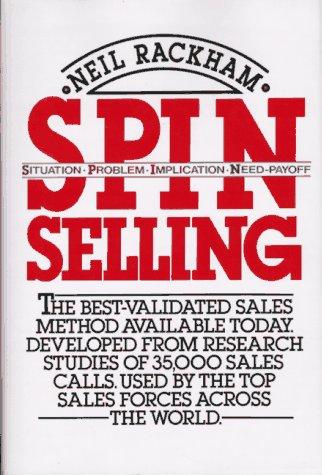
Talk to SPIN Selling like its author wrote you back.
Get the ideas that fit your life — not generic summaries.
- Chat with the book
- Audiobook-style main ideas
- Adapts to your life and goals
- Helps you take action
What it argues
SPIN Selling is Neil Rackham's distillation of twelve years of research and over 35,000 sales calls analyzed to determine what separates effective salespeople in complex, high-value B2B transactions from their less successful counterparts. Published in 1988, it remains one of the few sales books grounded in empirical research rather than practitioner intuition.
The central finding is that the questioning techniques taught in most sales training programs — open-ended questions, closed-ended questions, benefit statements — work adequately for small, transactional sales but fail in large, complex ones. For high-value sales with multiple stakeholders, longer evaluation periods, and significant switching costs, the game is different. Customers need to feel their own sense of urgency rather than being persuaded by the salesperson's enthusiasm, and that urgency is created through a specific sequence of questions rather than through product pitches.
What it gets right
- 1.
Small and large sales require fundamentally different techniques. Closing tactics and benefit statements that work for transactional sales actively hurt performance in complex, high-value ones.
- 2.
SPIN: Situation, Problem, Implication, Need-payoff. The sequence is not arbitrary — each question type builds on the previous to develop buyer-owned urgency.
- 3.
Problem questions surface dissatisfaction. But the number of problem questions alone doesn't predict sales success — it's what comes next that matters.
What it covers
Who wrote it
Neil Rackham is a researcher and consultant who founded Huthwaite International, a sales training and research organization. He led the twelve-year Huthwaite research project that analyzed 35,000 sales calls across twenty-three countries — the study that produced SPIN Selling. He has written several other sales books including Major Account Sales Strategy and Managing Major Sales. His work is notable for being grounded in behavioral research rather than practitioner experience, making it among the most credible empirical contributions to sales methodology.
