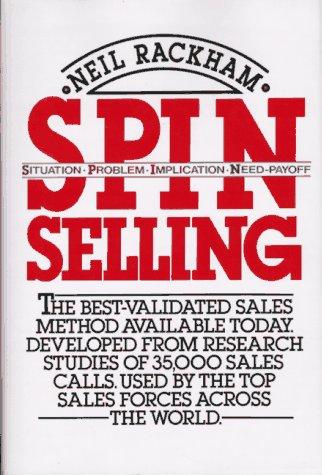
SPIN Selling by Neil Rackham is a 1988 business book about sales, b2b, customer discovery. Small and large sales require fundamentally different techniques. Closing tactics and benefit statements that work for transactional sales actively hurt performance in complex, high-value ones.
Summary
SPIN Selling is Neil Rackham's distillation of twelve years of research and over 35,000 sales calls analyzed to determine what separates effective salespeople in complex, high-value B2B transactions from their less successful counterparts. Published in 1988, it remains one of the few sales books grounded in empirical research rather than practitioner intuition.
The central finding is that the questioning techniques taught in most sales training programs — open-ended questions, closed-ended questions, benefit statements — work adequately for small, transactional sales but fail in large, complex ones. For high-value sales with multiple stakeholders, longer evaluation periods, and significant switching costs, the game is different. Customers need to feel their own sense of urgency rather than being persuaded by the salesperson's enthusiasm, and that urgency is created through a specific sequence of questions rather than through product pitches.
SPIN stands for Situation, Problem, Implication, and Need-payoff. Situation questions establish context. Problem questions surface dissatisfaction with the current situation. Implication questions are the most powerful: they explore the consequences and costs of the problem in ways that make the buyer feel the urgency themselves. Need-payoff questions invite the buyer to articulate the value of solving the problem, which is more persuasive than the salesperson describing the value. The questions build sequentially: situation leads to problem, problem leads to implication, implication creates urgency, and need-payoff questions help the buyer sell themselves.
The honest assessment: SPIN Selling is rigorous and the questioning framework is genuinely useful in complex sales. The writing is business-textbook dry, and the research was conducted in the 1970s and 1980s when B2B selling looked quite different. The rise of information-saturated buyers who arrive more prepared than Rackham's research subjects has changed some dynamics. But the core mechanism — questions that build buyer-owned urgency rather than seller-delivered pitches — transfers cleanly to modern selling.
Talk to SPIN Selling like its author wrote you back.
Get the ideas that fit your life — not generic summaries.
- Chat with the book
- Audiobook-style main ideas
- Adapts to your life and goals
- Helps you take action
Key takeaways
- 1.
Small and large sales require fundamentally different techniques. Closing tactics and benefit statements that work for transactional sales actively hurt performance in complex, high-value ones.
- 2.
SPIN: Situation, Problem, Implication, Need-payoff. The sequence is not arbitrary — each question type builds on the previous to develop buyer-owned urgency.
- 3.
Problem questions surface dissatisfaction. But the number of problem questions alone doesn't predict sales success — it's what comes next that matters.
- 4.
Implication questions are the most powerful tool in complex sales. They expand the customer's perception of a problem's consequences and cost without the seller having to argue for urgency.
- 5.
Need-payoff questions invite the buyer to articulate the value of solving the problem themselves. A buyer who states the benefit is more convinced than a buyer who was told the benefit.
- 6.
Premature closing — attempting to close before the buyer has developed sufficient urgency — is one of the most common and costly mistakes in large-account selling.
- 7.
Successful salespeople in complex sales ask fewer questions overall but more high-quality implication and need-payoff questions per call.
- 8.
The Advance is a more useful concept than the Close in complex sales: any action that moves the sale forward through the customer's decision process, not just a commitment to buy.
Discussion questions
Use these on your own, with a book club, or as chat starters in Superbook. Book club version, ready to copy or print →
- 1.
Rackham found that techniques effective in small sales actively hurt in large ones. Where else in business do you see a skill or approach that scales in the wrong direction as stakes increase?
- 2.
Think of a time you were persuaded to buy something expensive. Which of the SPIN question types best describes what made you feel urgency about the decision?
- 3.
What makes a well-constructed implication question different from just making the customer feel bad about their current situation?
- 4.
Need-payoff questions invite the buyer to state the value themselves. Why is this more persuasive than the salesperson stating it, and when does it feel manipulative rather than natural?
- 5.
SPIN Selling was researched in the 1970s and 1980s. Buyers now arrive more informed than they were then. What changes in the SPIN sequence make sense for a modern selling environment?
- 6.
The book distinguishes Advances from Closes. What's the right set of Advances to design for a complex B2B sales process you know well?
- 7.
How do you adapt the SPIN framework for discovery calls where you're gathering information rather than building urgency?
- 8.
What are the conditions under which a salesperson should not attempt to sell using SPIN — where the framework adds friction rather than removing it?
- 9.
Rackham found that high performers ask fewer total questions but more implication questions. What does that tell you about question quality versus quantity in a sales conversation?
- 10.
How does the SPIN framework interact with Challenger Sale-style teaching? Can you lead with insight and then use SPIN, or do they require different conversation structures?
- 11.
If you were training a new B2B salesperson, at what stage of their development would you introduce SPIN Selling, and what would you prioritize before it?
Themes
Frequently asked questions
-
Is SPIN Selling still relevant?
Yes. The questioning sequence is sound and the underlying mechanism — buyer-owned urgency through implication questions — remains one of the most effective techniques in complex sales. The specific examples are dated, and buyers now arrive more informed, but the core framework holds up.
-
How difficult is SPIN Selling to learn?
The concepts are clear; the execution takes practice. Implication questions in particular require preparation — you need to understand your buyer's business well enough to construct questions about consequences they haven't yet articulated. Most salespeople underinvest in situation and problem research, which makes implication questions shallow.
-
Does SPIN Selling apply to consumer sales?
The framework is designed for complex, high-value B2B sales. It applies less well to high-volume consumer or transactional sales where buyer decision cycles are short and the relationship is limited to a single conversation.
-
What is the difference between a Need-payoff question and a closing question?
A closing question asks for a commitment: Are you ready to move forward? A need-payoff question invites the buyer to articulate the value: If you could solve this problem, what would that be worth to your team? The first applies pressure; the second builds conviction. Rackham's research found that the latter is more effective in complex sales.
-
Should I read SPIN Selling before The Challenger Sale?
Either order works. SPIN Selling addresses the discovery and urgency-building phase of sales. The Challenger Sale addresses how to lead with insight before discovery. Reading both gives you a fuller model of complex B2B selling.