Fantasy · Book club
Spinning Silver book club questions
Here are 12 book club questions for Spinning Silver by Naomi Novik, ordered to open easily and end somewhere worth arguing about. Copy them, print them, or bring them up one at a time.
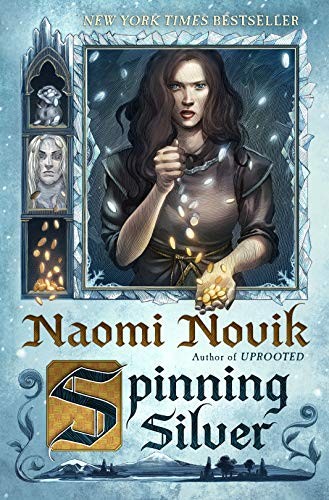
Spinning Silver is a loose retelling of Rumpelstiltskin set in a fantasy world inspired by medieval Eastern Europe, with particular roots in Russian and Jewish folk tradition.
Naomi Novik · 2018 · 14h 15m
Full summary and key takeaways →The 12 questions
- 1.
Miryem takes over her father's moneylending business and becomes good at it. The novel presents this as strength. Where does it complicate that presentation, if at all?
- 2.
The Staryk king makes Miryem an impossible bargain. By the end, the nature of that bargain has changed entirely. What does that transformation say about the novel's argument on power and negotiation?
- 3.
Novik is explicitly reworking antisemitic folklore — the greedy, cunning Jewish moneylender. Did the novel succeed in that reworking for you? Was there anything in its execution you found incomplete?
- 4.
The multiple POV structure takes a while to cohere. Did you find the initial disorientation worthwhile? Which narrator did you find most interesting, and does your answer say something about the kind of story you prefer?
- 5.
The novel's winter is literally encroaching on the world. How does the ecological dimension of the Staryk threat — winter as existential danger — shape your reading of the book's politics?
- 6.
Each of the three women forms an unlikely alliance with someone who initially seems like an adversary. What does Novik seem to believe about the relationship between power and alliance-making?
- 7.
Compared to Uprooted, Spinning Silver is cooler in temperature and more explicitly political. Do you find the warmer or the cooler version of Novik's fantasy more interesting?
- 8.
The novel's magic is fundamentally transactional — bargains, exchanges, transformations of value. How does that design reflect the story's thematic concerns?
- 9.
Wanda's situation — trapped with an abusive father, making choices to survive — is the most realist thread in a fantastical novel. Did her story feel continuous with the others or like it belonged to a different kind of book?
- 10.
The resolution hinges on Miryem understanding the deep logic of the Staryk's economy better than they do. Is that ending satisfying? Does the economic argument hold together?
- 11.
The Jewish identity in this novel is not incidental — it shapes Miryem's relationship to money, her community, and her danger. How does that specificity affect the universality of her story?
- 12.
If you read Uprooted first, how did that shape your expectations for Spinning Silver? Were those expectations met, exceeded, or productively disappointed?
How to run the discussion
- Pick six to eight, not all of them. An hour of real discussion covers fewer questions than anyone expects, and racing the list is what makes a book club feel like homework.
- Open with what people noticed, not what they concluded. Asking for a verdict first hardens opinions before anyone has heard each other.
- Let the disagreement run. The questions below that split a room are the ones worth the time; the ones everyone answers the same way can be skipped.
- Ask the quiet person a specific question. A direct, narrow question is far easier to answer than an open invitation to contribute.
Themes worth steering toward
If the conversation stalls, these are the threads that usually restart it.
Common questions
What are good book club questions for Spinning Silver?
Here are 12 book club questions for Spinning Silver by Naomi Novik, ordered to open easily and end somewhere worth arguing about. The strongest openers ask what each reader noticed rather than what they concluded, and the discussion usually turns on women and economic power, bargaining and survival, winter and magic.
How long should a book club discussion of Spinning Silver last?
Most groups run 60 to 90 minutes of actual discussion. That is roughly six to eight questions, not all of them, so pick the ones that suit your group rather than working down the list in order.
What are the main themes in Spinning Silver?
Women and economic power, Bargaining and survival, Winter and magic, Jewish identity and antisemitism, Unexpected alliances. Those are the threads most likely to divide a room, which makes them the useful places to steer a discussion that has gone quiet.
Picking the next one? See books like Spinning Silver or questions for other book club picks.
