Self-help · Book club
Steal Like an Artist book club questions
Here are 11 book club questions for Steal Like an Artist by Austin Kleon, ordered to open easily and end somewhere worth arguing about. Copy them, print them, or bring them up one at a time.
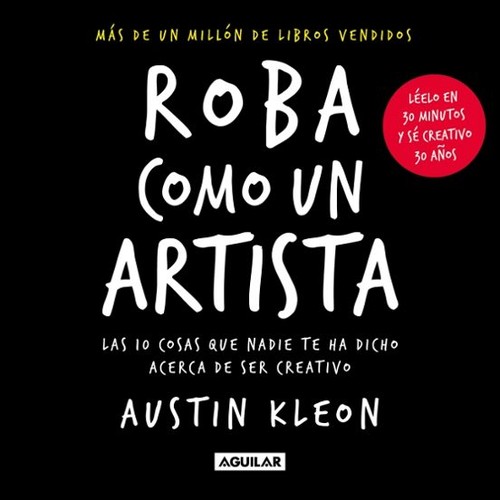
Steal Like an Artist is Austin Kleon's short, illustrated guide to the creative process, built around the premise that nothing is truly original — all creative work is built from and inspired by what came before.
Austin Kleon · 2012 · 1h 20m
Full summary and key takeaways →The 11 questions
- 1.
Kleon argues that all creative work is built from prior influences. Who are the three creative people — in any field — whose influence is most visible in your own work or thinking?
- 2.
He says to start before you feel ready. What creative project are you currently waiting to start until you feel more prepared or capable? What is the minimum viable version you could begin this week?
- 3.
Kleon advises working with your hands as a creative practice. Do you have any analog creative practice — drawing, writing by hand, making physical objects? What does it produce that your digital work doesn't?
- 4.
The book encourages building a creative genealogy. Pick one person whose work you love and trace backward: who did they learn from? Where does the lineage lead?
- 5.
Side projects are often where creative breakthroughs happen because the stakes are low. What is your current side project? If you don't have one, what would you start if it were purely for yourself?
- 6.
Kleon says constraints are creative fuel. What self-imposed constraint could you put on a current creative project to make it more interesting?
- 7.
He argues that you make the work you want to see in the world. What is something that doesn't exist yet that you desperately want? Could you be the one to make it?
- 8.
The advice to 'be boring' — stable routines, predictable logistics — to free up creative capacity is counterintuitive. How chaotic or stable is your daily life? What does that cost or enable creatively?
- 9.
Kleon describes 'creative theft' as deeply transformative, not imitative. What's the difference, in your own experience, between imitating someone and being genuinely influenced by them?
- 10.
The book is itself a demonstration of its ideas — designed and illustrated unconventionally. How does the form of a creative work affect how you receive its content?
- 11.
What would your life look like if you treated every day as an opportunity to make something, however small — a sentence, a sketch, a photo — rather than waiting for a dedicated creative block?
How to run the discussion
- Pick six to eight, not all of them. An hour of real discussion covers fewer questions than anyone expects, and racing the list is what makes a book club feel like homework.
- Open with what people noticed, not what they concluded. Asking for a verdict first hardens opinions before anyone has heard each other.
- Let the disagreement run. The questions below that split a room are the ones worth the time; the ones everyone answers the same way can be skipped.
- Ask the quiet person a specific question. A direct, narrow question is far easier to answer than an open invitation to contribute.
Themes worth steering toward
If the conversation stalls, these are the threads that usually restart it.
Common questions
What are good book club questions for Steal Like an Artist?
Here are 11 book club questions for Steal Like an Artist by Austin Kleon, ordered to open easily and end somewhere worth arguing about. The strongest openers ask what each reader noticed rather than what they concluded, and the discussion usually turns on creativity, influence, creative work.
How long should a book club discussion of Steal Like an Artist last?
Most groups run 60 to 90 minutes of actual discussion. That is roughly six to eight questions, not all of them, so pick the ones that suit your group rather than working down the list in order.
What are the main themes in Steal Like an Artist?
Creativity, Influence, Creative work, Originality, Craft. Those are the threads most likely to divide a room, which makes them the useful places to steer a discussion that has gone quiet.
Picking the next one? See books like Steal Like an Artist or questions for other book club picks.
