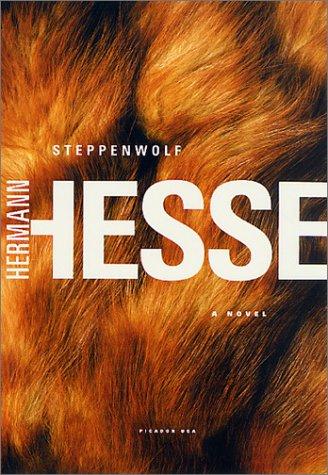
Talk to Steppenwolf like its author wrote you back.
Get the ideas that fit your life — not generic summaries.
- Chat with the book
- Audiobook-style main ideas
- Adapts to your life and goals
- Helps you take action
What it argues
Steppenwolf is Hermann Hesse's most psychologically intense and formally inventive novel, published in 1927 at a time of personal crisis. The protagonist, Harry Haller, is a middle-aged intellectual who sees himself as divided between a respectable bourgeois self and a wild, solitary wolf — the Steppenwolf of the title. He is contemptuous of middle-class culture, incapable of sustained human connection, and oscillating between the impulse toward transcendence and a recurring desire for self-destruction.
The novel's structure mirrors its themes. It begins as a realistic third-person account of a lodger, shifts to Haller's own journals, and eventually dissolves into the surrealist dreamscape of the Magic Theatre — "for madmen only, price of admission your mind." The Magic Theatre is a series of rooms in which Haller's psychological multiplicities are dramatized: his idealizations, his repressions, his capacities for both violence and transcendence. It is one of the more original formal experiments in 20th-century literature.
What it gets right
- 1.
The self is not dual but multiple: the wolf/bourgeois opposition is itself a simplification, and genuine self-knowledge requires acknowledging the full multitude.
- 2.
Bourgeois comfort and intellectual contempt for it are mirror images: each defines itself against the other, and neither constitutes genuine liberation.
- 3.
Humor — the laughter of the Immortals, the cosmic perspective from which all human suffering looks bearable — is the highest human capacity in the novel.
What it covers
Who wrote it
Hermann Hesse (1877–1962) was a German-Swiss novelist, poet, and Nobel laureate who became one of the best-selling German-language authors of the 20th century. Born to missionary parents with roots in both European Christianity and Indian spiritual culture, he underwent several spiritual and psychological crises, including psychoanalytic work with a disciple of C. G. Jung, that shaped his fiction. Steppenwolf (1927), written during a period of intense personal turmoil, became his most celebrated and controversial novel. He received the Nobel Prize in Literature in 1946 for the totality of his work.
