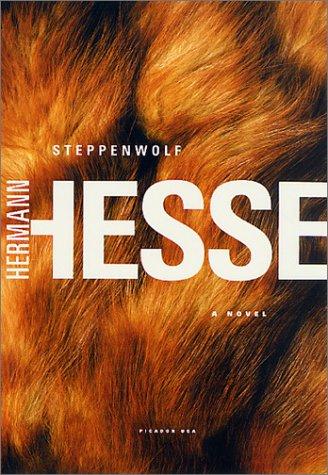
Talk to Steppenwolf like its author wrote you back.
Get the ideas that fit your life — not generic summaries.
- Chat with the book
- Audiobook-style main ideas
- Adapts to your life and goals
- Helps you take action
Steppenwolf, in detail
Steppenwolf is Hermann Hesse's most psychologically intense and formally inventive novel, published in 1927 at a time of personal crisis. The protagonist, Harry Haller, is a middle-aged intellectual who sees himself as divided between a respectable bourgeois self and a wild, solitary wolf — the Steppenwolf of the title. He is contemptuous of middle-class culture, incapable of sustained human connection, and oscillating between the impulse toward transcendence and a recurring desire for self-destruction.
The novel's structure mirrors its themes. It begins as a realistic third-person account of a lodger, shifts to Haller's own journals, and eventually dissolves into the surrealist dreamscape of the Magic Theatre — "for madmen only, price of admission your mind." The Magic Theatre is a series of rooms in which Haller's psychological multiplicities are dramatized: his idealizations, his repressions, his capacities for both violence and transcendence. It is one of the more original formal experiments in 20th-century literature.
The philosophical burden of the novel concerns the "Treatise on the Steppenwolf" — an anonymous pamphlet that Haller receives and that recasts his self-understanding. The Treatise argues that the opposition between the bourgeois and the wolf is itself a simplification; Haller is not dual but multiple, and the path to liberation lies not in resolving the opposition but in recognizing that the self is a multitude. The Immortals — Mozart and Goethe, who appear in hallucinatory passages — represent the possibility of a consciousness large enough to hold multiplicity with laughter rather than despair.
Steppenwolf has been read as a diagnosis of intellectual alienation, as an autobiography of spiritual crisis, as a prefiguration of psychedelic experience, and as a manual for how to live with contradictions too large to resolve. Hesse himself was concerned that readers took it as a celebration of Harry's alienation rather than a critique of it. The Immortals laugh. That is the resolution, such as it is.
The big ideas
- 1.
The self is not dual but multiple: the wolf/bourgeois opposition is itself a simplification, and genuine self-knowledge requires acknowledging the full multitude.
- 2.
Bourgeois comfort and intellectual contempt for it are mirror images: each defines itself against the other, and neither constitutes genuine liberation.
- 3.
Humor — the laughter of the Immortals, the cosmic perspective from which all human suffering looks bearable — is the highest human capacity in the novel.
