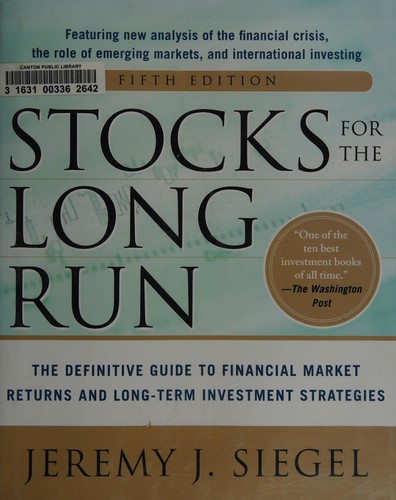
Talk to Stocks for the Long Run like its author wrote you back.
Get the ideas that fit your life — not generic summaries.
- Chat with the book
- Audiobook-style main ideas
- Adapts to your life and goals
- Helps you take action
What it argues
Stocks for the Long Run is Jeremy Siegel's comprehensive empirical case for equities as the dominant long-term asset class. The Wharton finance professor assembled nearly 200 years of US market data to argue that stocks — despite their volatility over any short horizon — have produced superior inflation-adjusted returns compared to bonds, gold, and cash over every 30-year period in American history. The first edition appeared in 1994 and has been updated through multiple editions as Siegel incorporated new data and responded to critics.
The book's central finding is blunt: the real return on stocks has averaged roughly 6.5 to 7 percent per year over two centuries, a figure that has remained remarkably stable across periods of war, deflation, inflation, financial crisis, and political turmoil. Bonds and Treasury bills have historically underperformed stocks on a real basis over long periods, despite being perceived as safer. Siegel's conclusion is that for investors with long horizons — 20 years or more — equities are not merely acceptable but are the lowest-risk way to maintain purchasing power.
What it gets right
- 1.
Over every 20- to 30-year period in US history, stocks have outperformed bonds, gold, and cash on an inflation-adjusted basis. Time horizon is the most important variable in risk management.
- 2.
The real return on US equities has averaged roughly 6.5 to 7 percent per year over nearly two centuries, a figure stable enough that Siegel calls it the Siegel constant.
- 3.
Short-term stock volatility is high, but long-term return volatility is lower than bonds. Holding stocks for 20 years reduces real return variance below that of bonds held for the same period.
What it covers
Who wrote it
Jeremy J. Siegel is the Russell E. Palmer Professor of Finance at the Wharton School of the University of Pennsylvania, where he has taught since 1976. He is one of the most widely cited academic finance economists in the country and a frequent commentator on financial markets. In addition to Stocks for the Long Run, he has written The Future for Investors, which examines long-term sector returns and the role of dividends. He contributes to financial media and has testified before Congress on capital markets and financial regulation.
