Talk to Stocks for the Long Run like its author wrote you back.
Get the ideas that fit your life — not generic summaries.
- Chat with the book
- Audiobook-style main ideas
- Adapts to your life and goals
- Helps you take action
Stocks for the Long Run, in detail
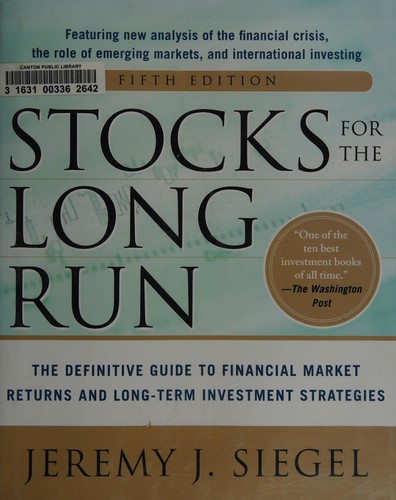
Stocks for the Long Run is Jeremy Siegel's comprehensive empirical case for equities as the dominant long-term asset class. The Wharton finance professor assembled nearly 200 years of US market data to argue that stocks — despite their volatility over any short horizon — have produced superior inflation-adjusted returns compared to bonds, gold, and cash over every 30-year period in American history. The first edition appeared in 1994 and has been updated through multiple editions as Siegel incorporated new data and responded to critics.
The book's central finding is blunt: the real return on stocks has averaged roughly 6.5 to 7 percent per year over two centuries, a figure that has remained remarkably stable across periods of war, deflation, inflation, financial crisis, and political turmoil. Bonds and Treasury bills have historically underperformed stocks on a real basis over long periods, despite being perceived as safer. Siegel's conclusion is that for investors with long horizons — 20 years or more — equities are not merely acceptable but are the lowest-risk way to maintain purchasing power.
Beyond the central thesis, the book covers stock valuation, the impact of taxes and inflation on different asset classes, international diversification, sector investing, and the historical behavior of the stock market during economic crises. Later editions address factors investing, the equity risk premium debate, and how globalization has changed the calculus for US investors. It is a reference as much as a narrative, and many readers treat it as such.
The limitation is the reliance on US historical data. Critics note that US market performance over two centuries may reflect survivorship bias — the US happened to be the dominant economy; other countries' markets did not always recover from setbacks. Siegel addresses this challenge in later editions but does not fully resolve it. The book is most useful as a historical grounding for why long-term equity investing has earned its reputation, rather than a guarantee about what future returns will be.
The big ideas
- 1.
Over every 20- to 30-year period in US history, stocks have outperformed bonds, gold, and cash on an inflation-adjusted basis. Time horizon is the most important variable in risk management.
- 2.
The real return on US equities has averaged roughly 6.5 to 7 percent per year over nearly two centuries, a figure stable enough that Siegel calls it the Siegel constant.
- 3.
Short-term stock volatility is high, but long-term return volatility is lower than bonds. Holding stocks for 20 years reduces real return variance below that of bonds held for the same period.
