Psychology · Book club
Stolen Focus: Why You Can't Pay Attention—and How to Think Deeply Again book club questions
Here are 12 book club questions for Stolen Focus: Why You Can't Pay Attention—and How to Think Deeply Again by Johann Hari, ordered to open easily and end somewhere worth arguing about. Copy them, print them, or bring them up one at a time.
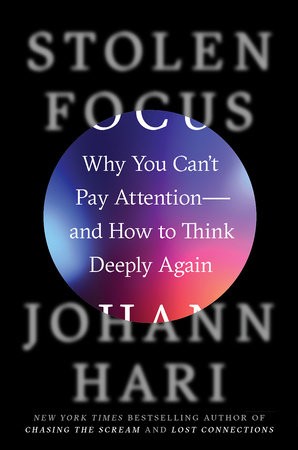
Johann Hari's argument is that the collapse of attention is not a personal failing but a political crisis.
Johann Hari · 2022 · 6h 15m
Full summary and key takeaways →The 12 questions
- 1.
Hari argues the attention crisis is a political problem, not a personal one. Do you find that framing liberating or does it remove too much individual accountability?
- 2.
Which of Hari's twelve causes of the attention crisis resonates most with your own experience? Which seems least convincing?
- 3.
How much of your daily attention do you voluntarily give to social media, and how much does it feel genuinely chosen?
- 4.
Hari spends three months offline and reports significant benefits. What would you expect to happen to your attention and mental state if you went offline for that long?
- 5.
The book draws a parallel between the attention economy and the tobacco industry. How far does that parallel hold, and where does it break down?
- 6.
Tristan Harris argues that design ethics is insufficient reform — the business model must change. Do you agree, and what would changing the business model require politically?
- 7.
Hari is open about his own attention problems and his reliance on stimulant medication. Does his personal vulnerability make the argument more or less credible to you?
- 8.
The chapter on reading argues that the decline of long books is both a symptom and a cause of the attention collapse. What does your own reading life suggest about this claim?
- 9.
Flow states require sustained, difficult engagement. What was the last time you experienced genuine flow, and what conditions made it possible?
- 10.
The book ends with a call for collective political action. What would an effective political movement for attention rights actually look like?
- 11.
If you could make one change — structural or personal — to protect your attention, what would it be and why haven't you made it yet?
- 12.
Hari interviews both tech insiders who want to reform the system and critics who think reform is impossible. Which perspective do you find more credible?
How to run the discussion
- Pick six to eight, not all of them. An hour of real discussion covers fewer questions than anyone expects, and racing the list is what makes a book club feel like homework.
- Open with what people noticed, not what they concluded. Asking for a verdict first hardens opinions before anyone has heard each other.
- Let the disagreement run. The questions below that split a room are the ones worth the time; the ones everyone answers the same way can be skipped.
- Ask the quiet person a specific question. A direct, narrow question is far easier to answer than an open invitation to contribute.
Themes worth steering toward
If the conversation stalls, these are the threads that usually restart it.
Common questions
What are good book club questions for Stolen Focus: Why You Can't Pay Attention—and How to Think Deeply Again?
Here are 12 book club questions for Stolen Focus: Why You Can't Pay Attention—and How to Think Deeply Again by Johann Hari, ordered to open easily and end somewhere worth arguing about. The strongest openers ask what each reader noticed rather than what they concluded, and the discussion usually turns on attention, technology, focus.
How long should a book club discussion of Stolen Focus: Why You Can't Pay Attention—and How to Think Deeply Again last?
Most groups run 60 to 90 minutes of actual discussion. That is roughly six to eight questions, not all of them, so pick the ones that suit your group rather than working down the list in order.
What are the main themes in Stolen Focus: Why You Can't Pay Attention—and How to Think Deeply Again?
Attention, Technology, Focus, Mental health, Society. Those are the threads most likely to divide a room, which makes them the useful places to steer a discussion that has gone quiet.
Picking the next one? See books like Stolen Focus: Why You Can't Pay Attention—and How to Think Deeply Again or questions for other book club picks.
