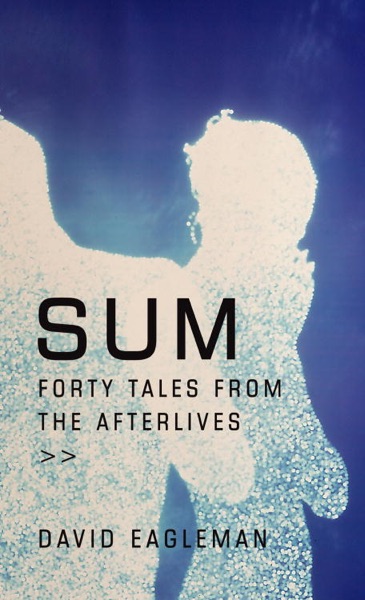
Talk to Sum: Forty Tales from the Afterlives like its author wrote you back.
Get the ideas that fit your life — not generic summaries.
- Chat with the book
- Audiobook-style main ideas
- Adapts to your life and goals
- Helps you take action
What it argues
Sum: Forty Tales from the Afterlives is a collection of forty short, fictional vignettes, each imagining a different version of what happens after death. Neuroscientist David Eagleman wrote the book not as theology but as philosophical play: a way of examining what the afterlife scenarios say about human concerns, assumptions, and the nature of consciousness. Each tale is typically two to four pages and inverts or subverts a common expectation about reward, punishment, identity, or meaning.
In the title story, you relive all your life's experiences sorted by type: all your hours of waiting grouped together, all your moments of joy, all your episodes of embarrassment. What seems like a benign afterlife becomes quietly horrifying as the tedium accumulates. Other tales are gentler. In one, God turns out to be a microscopic creature who created humans for reasons entirely unrelated to human concerns. In another, you discover the afterlife is a bureaucratic place where you must wait for everyone who ever knew you to also die before you can fully cease to exist.
What it gets right
- 1.
The afterlife scenarios in Sum function as thought experiments about what matters in life — each one isolates a human assumption and subjects it to imaginative pressure.
- 2.
The title story shows how the same experiences reorganized can change their meaning entirely: joy aggregated becomes a manic episode, waiting accumulated becomes a kind of hell.
- 3.
Eagleman returns repeatedly to the question of whether identity requires continuity — whether a 'you' without your memories and relationships is still you.
What it covers
Who wrote it
David Eagleman is an American neuroscientist and author who holds adjunct professorships at Stanford University. His popular science books include Incognito: The Secret Lives of the Brain (2011), The Brain (2015), and Livewired (2020), and he created and hosted the PBS series The Brain with David Eagleman. Sum was his first book and remains something of an outlier in his catalog — purely literary rather than scientific. He is also a co-founder of Neosensory, a company developing devices that expand human perception through sensory substitution.
