Sum: Forty Tales from the Afterlives by David Eagleman is a 2009 philosophy book about consciousness, meaning, mortality. The afterlife scenarios in Sum function as thought experiments about what matters in life — each one isolates a human assumption and subjects it to imaginative pressure.
Summary
Sum: Forty Tales from the Afterlives is a collection of forty short, fictional vignettes, each imagining a different version of what happens after death. Neuroscientist David Eagleman wrote the book not as theology but as philosophical play: a way of examining what the afterlife scenarios say about human concerns, assumptions, and the nature of consciousness. Each tale is typically two to four pages and inverts or subverts a common expectation about reward, punishment, identity, or meaning.
In the title story, you relive all your life's experiences sorted by type: all your hours of waiting grouped together, all your moments of joy, all your episodes of embarrassment. What seems like a benign afterlife becomes quietly horrifying as the tedium accumulates. Other tales are gentler. In one, God turns out to be a microscopic creature who created humans for reasons entirely unrelated to human concerns. In another, you discover the afterlife is a bureaucratic place where you must wait for everyone who ever knew you to also die before you can fully cease to exist.
The book does not argue for a particular view of consciousness or mortality. It uses the imaginative freedom of fiction to ask questions that philosophy often poses abstractly: what is a self without memory? Is immortality desirable if you remain unchanged? What would it mean if your creator turned out to be indifferent to you? Each vignette functions as a thought experiment with an emotional core, and the book moves between comic, melancholy, and strange in ways that prevent it from settling into any one register.
Eagleman wrote Sum before his more systematic popular science works on the brain. The book shows a different side: literary, speculative, and concerned less with what neuroscience says about consciousness than with what it means that consciousness exists at all. It is among the rare science-adjacent works that can be recommended to readers with no interest in science, and also to scientists who want to think about their subject from the outside.
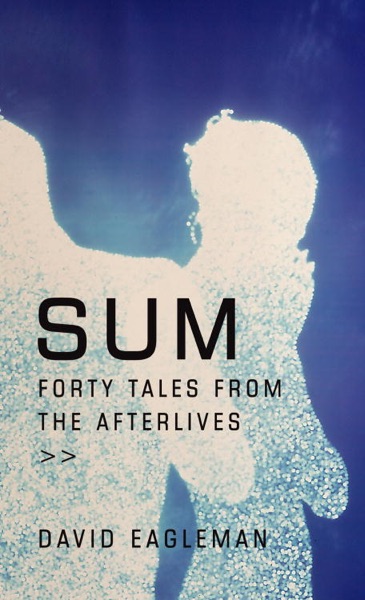
Talk to Sum: Forty Tales from the Afterlives like its author wrote you back.
Get the ideas that fit your life — not generic summaries.
- Chat with the book
- Audiobook-style main ideas
- Adapts to your life and goals
- Helps you take action
Key takeaways
- 1.
The afterlife scenarios in Sum function as thought experiments about what matters in life — each one isolates a human assumption and subjects it to imaginative pressure.
- 2.
The title story shows how the same experiences reorganized can change their meaning entirely: joy aggregated becomes a manic episode, waiting accumulated becomes a kind of hell.
- 3.
Eagleman returns repeatedly to the question of whether identity requires continuity — whether a 'you' without your memories and relationships is still you.
- 4.
Many of the stories suggest that immortality, examined closely, contains more horror than appeal: change without death becomes stagnation.
- 5.
The stories resist theological framework — God appears in several as indifferent, mistaken, or simply unaware, which is a different kind of discomfort than conventional atheism.
- 6.
The book treats consciousness as genuinely mysterious without resolving the mystery — it is content to sit with the strangeness of existing and then not existing.
- 7.
Sum works as a book about grief as much as about death: several vignettes model what it would mean to keep existing when the people who made you who you are have gone.
Discussion questions
Use these on your own, with a book club, or as chat starters in Superbook. Book club version, ready to copy or print →
- 1.
Which of the forty afterlives disturbed you most, and why? What does that reaction tell you about what you value?
- 2.
The title story reorganizes a life's experiences by type rather than by sequence. What would your life look like organized that way, and is there anything in that reorganization you find clarifying?
- 3.
Several stories suggest that immortality would be unbearable. Do you find that argument convincing, or does it depend too much on assuming people cannot change?
- 4.
Eagleman's gods are mostly indifferent, mistaken, or bounded by their own limits. Is that more unsettling than a world with no god at all, or less?
- 5.
The book is about death but reads like it is about life. Which stories felt most like a reflection on how you are living now rather than what might happen after?
- 6.
Some vignettes turn on identity: what happens to a 'you' that lacks memory, relationships, or embodiment. What do you think makes you continuous with the person you were ten years ago?
- 7.
The format — very short pieces, no common thread — could have made the book feel scattered. Does it hold together as a unified work for you, or is it better read as individual pieces?
- 8.
Eagleman is a neuroscientist writing fiction. Does knowing his background change how you read the stories? Do they feel more or less like thought experiments because of it?
- 9.
Which afterlife from the book would you most choose, if that were an option? What does your answer say about what you most want from existence?
- 10.
The book has almost no conventional narrative arc or characters. What makes it engaging despite the absence of story in the usual sense?
- 11.
Sum was written before Eagleman's popular neuroscience books. Does it feel continuous with that work, or like a different kind of thinking entirely?
Themes
Frequently asked questions
-
Is Sum worth reading?
Yes, especially for readers who want a short, unusual book that opens questions rather than closing them. It takes about two hours to read and almost every piece rewards a second read. It is also a useful gift for people who are grieving or thinking about mortality.
-
Is Sum fiction or nonfiction?
Fiction — explicitly so. The subtitle 'Forty Tales from the Afterlives' signals that none of the scenarios are presented as literal claims. But Eagleman uses the fictional form to explore questions that matter philosophically.
-
Do you need to be religious to appreciate Sum?
No. The book does not presuppose religious belief and does not argue for or against it. The afterlife scenarios are imaginative premises, not theological arguments. Atheists, agnostics, and believers tend to find it equally engaging.
-
How long is Sum?
About 110 pages — two hours at a comfortable pace. The pieces are very short, which makes it easy to read in sessions of a few minutes. Many readers finish it in a single sitting anyway.
-
Who should read Sum?
Anyone who has thought seriously about death, consciousness, or identity, and is willing to approach those questions through fiction rather than argument. It works well in book clubs because each vignette generates a different conversation.
Similar books
Man's Search for Meaning
Viktor E. Frankl
The Examined Life: How We Lose and Find Ourselves
Stephen Grosz
Incognito: The Secret Lives of the Brain
David Eagleman
Consciousness Explained
Daniel C. Dennett
