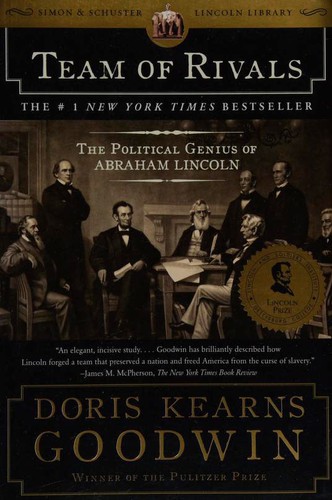
Talk to Team of Rivals: The Political Genius of Abraham Lincoln like its author wrote you back.
Get the ideas that fit your life — not generic summaries.
- Chat with the book
- Audiobook-style main ideas
- Adapts to your life and goals
- Helps you take action
Team of Rivals: The Political Genius of Abraham Lincoln, in detail
Doris Kearns Goodwin's account of Abraham Lincoln's formation of his cabinet — which included his three main rivals for the 1860 Republican nomination: William Seward, Salmon Chase, and Edward Bates — is one of the most widely discussed leadership books of the twenty-first century and one of the most readable biographies of the Lincoln era. Published in 2005, it was the book President Obama cited most frequently as informing his own approach to assembling a cabinet of rivals, and it provided the basis for Steven Spielberg's 2012 film Lincoln.
The book's structure is its argument. By following Seward, Chase, and Bates from their own beginnings through to the 1860 nomination, and then tracking their service under Lincoln, Goodwin can show what was remarkable about Lincoln's political intelligence through contrast. Where the others were prideful, easily wounded, and prone to factional thinking, Lincoln was comfortable with criticism, strategically patient, and able to subordinate his own ego to the goal he was pursuing. This is not hagiography — Goodwin is attentive to Lincoln's political calculations and occasional duplicity — but she argues convincingly that his emotional intelligence was his most unusual quality.
The war years dominate the book's second half. Goodwin traces the cabinet's internal politics — Chase's persistent ambition to replace Lincoln on the 1864 ticket, Seward's transformation from presumptuous rival to loyal partner, the shifting cast of generals — against the larger canvas of the war's military and moral evolution. The Emancipation Proclamation's development, from cautious political instrument to moral declaration, is given sustained attention: Goodwin shows how Lincoln moved faster than his cabinet and slower than the abolitionists, calibrating each step against public opinion and military necessity simultaneously.
The assassination chapter, which ends the book, is deliberately compressed. Goodwin has spent 700 pages building to Lincoln's second inaugural address — "with malice toward none, with charity for all" — and then the story is over in a few pages. The abruptness is a formal choice: the tragedy of what followed is present in the gap between the vision he articulated and the reconstruction that was actually carried out.
The big ideas
- 1.
Assembling rivals rather than loyalists signals a confidence in one's own ability to hold a team together. Lincoln's cabinet choice reflected this confidence and also his understanding that the nation's best people needed to be involved.
- 2.
Emotional intelligence in leadership means managing your own ego and understanding others' motivations without judging them by your own standards.
- 3.
The Emancipation Proclamation was both a moral act and a strategic calculation. Lincoln timed it to maximize its political and military impact, which does not diminish its moral significance.
