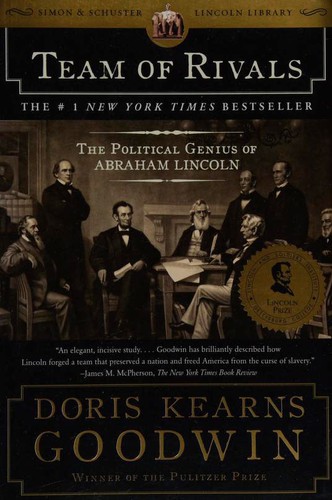
Team of Rivals: The Political Genius of Abraham Lincoln by Doris Kearns Goodwin is a 2005 biography book about leadership, politics, civil war. Assembling rivals rather than loyalists signals a confidence in one's own ability to hold a team together. Lincoln's cabinet choice reflected this confidence and also his understanding that the nation's best people needed to be involved.
Summary
Doris Kearns Goodwin's account of Abraham Lincoln's formation of his cabinet — which included his three main rivals for the 1860 Republican nomination: William Seward, Salmon Chase, and Edward Bates — is one of the most widely discussed leadership books of the twenty-first century and one of the most readable biographies of the Lincoln era. Published in 2005, it was the book President Obama cited most frequently as informing his own approach to assembling a cabinet of rivals, and it provided the basis for Steven Spielberg's 2012 film Lincoln.
The book's structure is its argument. By following Seward, Chase, and Bates from their own beginnings through to the 1860 nomination, and then tracking their service under Lincoln, Goodwin can show what was remarkable about Lincoln's political intelligence through contrast. Where the others were prideful, easily wounded, and prone to factional thinking, Lincoln was comfortable with criticism, strategically patient, and able to subordinate his own ego to the goal he was pursuing. This is not hagiography — Goodwin is attentive to Lincoln's political calculations and occasional duplicity — but she argues convincingly that his emotional intelligence was his most unusual quality.
The war years dominate the book's second half. Goodwin traces the cabinet's internal politics — Chase's persistent ambition to replace Lincoln on the 1864 ticket, Seward's transformation from presumptuous rival to loyal partner, the shifting cast of generals — against the larger canvas of the war's military and moral evolution. The Emancipation Proclamation's development, from cautious political instrument to moral declaration, is given sustained attention: Goodwin shows how Lincoln moved faster than his cabinet and slower than the abolitionists, calibrating each step against public opinion and military necessity simultaneously.
The assassination chapter, which ends the book, is deliberately compressed. Goodwin has spent 700 pages building to Lincoln's second inaugural address — "with malice toward none, with charity for all" — and then the story is over in a few pages. The abruptness is a formal choice: the tragedy of what followed is present in the gap between the vision he articulated and the reconstruction that was actually carried out.
Talk to Team of Rivals: The Political Genius of Abraham Lincoln like its author wrote you back.
Get the ideas that fit your life — not generic summaries.
- Chat with the book
- Audiobook-style main ideas
- Adapts to your life and goals
- Helps you take action
Key takeaways
- 1.
Assembling rivals rather than loyalists signals a confidence in one's own ability to hold a team together. Lincoln's cabinet choice reflected this confidence and also his understanding that the nation's best people needed to be involved.
- 2.
Emotional intelligence in leadership means managing your own ego and understanding others' motivations without judging them by your own standards.
- 3.
The Emancipation Proclamation was both a moral act and a strategic calculation. Lincoln timed it to maximize its political and military impact, which does not diminish its moral significance.
- 4.
Patience in political leadership is a skill, not a personality trait. Lincoln waited when others would have acted and acted when others would have waited, and the results were often decisive.
- 5.
Goodwin's multi-biographical structure shows that Lincoln's qualities become visible through comparison. Reading Seward and Chase alongside Lincoln explains Lincoln.
- 6.
The Civil War required Lincoln to develop as a military strategist as well as a political one. His education in war through the first two years shaped his eventual effectiveness.
- 7.
Relationships between rivals can become genuine partnerships if the dominant party is large enough to give credit and absorb criticism. Lincoln made Seward believe he was a valued partner, which he was.
- 8.
The second inaugural address is Lincoln's intellectual peak — more philosophically serious than most presidential rhetoric before or since — and the book argues it could only have been produced by the preceding four years of suffering and growth.
Discussion questions
Use these on your own, with a book club, or as chat starters in Superbook. Book club version, ready to copy or print →
- 1.
Lincoln deliberately chose rivals for his cabinet. Under what conditions is this a wise strategy, and when might it fail?
- 2.
Goodwin describes Lincoln's emotional intelligence as his most unusual quality. What specific behaviors does the book cite as evidence?
- 3.
The book has been used as a leadership manual by politicians across the political spectrum. Does that broad appropriation suggest the lessons are genuinely universal, or that the book is too vague to be challenged?
- 4.
Salmon Chase spent much of the war trying to replace Lincoln. How does Lincoln's decision to keep him in the cabinet, and then to appoint him Chief Justice, reflect his political philosophy?
- 5.
The Emancipation Proclamation is described as both morally necessary and politically calculated. Does the calculation diminish the moral significance?
- 6.
Goodwin's research required synthesizing an enormous number of primary sources — diaries, letters, official records. What does that research depth add to the reading experience?
- 7.
The book was criticized after publication for some overlapping language with other historians' works. Does that controversy affect how you read it?
- 8.
Lincoln is described as genuinely funny — a teller of bawdy jokes who used humor strategically. How does that quality fit with the Lincoln of the second inaugural address?
- 9.
The book ends with the assassination compressed into a few pages. Does that abruptness work as a formal choice?
- 10.
What does Team of Rivals suggest about the qualities that distinguish effective from merely capable political leadership?
- 11.
The book influenced Obama's cabinet choices. What parallels between Obama's situation and Lincoln's does the comparison illuminate, and where does it mislead?
Themes
Frequently asked questions
-
Is Team of Rivals suitable for readers who already know Lincoln well?
Yes. The multi-biographical structure gives even Lincoln experts a different angle of vision by tracing Seward, Chase, and Bates in comparable depth. The cabinet's internal politics are also given more detail than most single-subject Lincoln biographies.
-
How long does Team of Rivals take to read?
About eighteen to twenty hours. At nearly 800 pages it is a substantial commitment, but the narrative pace is strong throughout. Most readers find they can move quickly even through the densest political sections.
-
Was Obama's use of the book as a model accurate?
He said he drew from it the idea of including rivals and critics in the cabinet. Political observers have debated whether his cabinet actually resembled Lincoln's — the historical parallels are instructive but imperfect.
-
Did Goodwin actually plagiarize other historians?
In 2002 it was revealed that Goodwin's earlier book The Fitzgeralds and the Kennedys contained passages very similar to those in Lynne McTaggart's biography of Kathleen Kennedy, apparently due to research note-taking errors. She settled with McTaggart. Team of Rivals was written afterward with greater care. The controversy is real but separate from the quality of the Lincoln book.
-
How does the book compare to other Lincoln biographies?
David Herbert Donald's single-volume Lincoln is more psychologically penetrating. Gore Vidal's Lincoln novel captures different aspects of the man. Goodwin's multi-biographical structure is distinctive, and the book's value is specifically in its comparative approach and its accessibility to general readers.