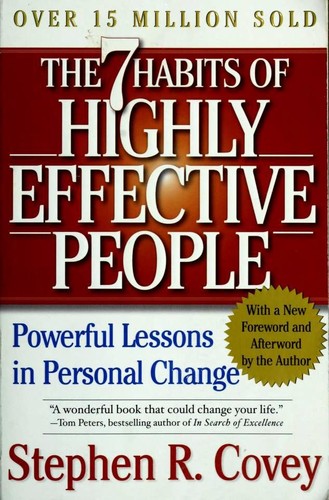
Talk to The 7 Habits of Highly Effective People like its author wrote you back.
Get the ideas that fit your life — not generic summaries.
- Chat with the book
- Audiobook-style main ideas
- Adapts to your life and goals
- Helps you take action
What it argues
Stephen R. Covey's argument is that most self-improvement advice treats symptoms rather than causes. He draws a contrast between the "personality ethic" — the techniques and shortcuts that dominated popular success literature after World War I — and the "character ethic" that dominated prior to it. Covey's claim is that lasting effectiveness has to be built on principles like integrity, humility, and fairness, not on tactics for making people like you. The seven habits are meant to be an integrated system, not a checklist.
The first three habits address what Covey calls the private victory: becoming independent in a mature, principled way. Be proactive means taking responsibility for your own choices rather than attributing your responses to circumstances or other people. Begin with the end in mind means clarifying your values and long-term goals before letting urgent tasks drive your days. Put first things first means scheduling around those priorities rather than reacting to whatever feels pressing. Covey illustrates this last habit with a time-management matrix that separates the important from the merely urgent — the insight being that most people spend their time in urgent but unimportant quadrants and neglect the important but non-urgent work that actually moves life forward.
What it gets right
- 1.
The personality ethic (techniques and image) cannot substitute for the character ethic (integrity, humility, fairness). Lasting effectiveness is built on principles, not on shortcuts.
- 2.
Be proactive means your responses to events are chosen, not conditioned. Between stimulus and response, there is always a space — and that space is where your freedom lives.
- 3.
Beginning with the end in mind means writing a personal mission statement and letting it govern decisions before urgency does. Most people drift because they never clarify what they actually want.
What it covers
Who wrote it
Stephen R. Covey (1932–2012) was an American educator, author, and management consultant. He earned an MBA from Harvard and a doctorate from Brigham Young University, where he later served as a professor and founding director of the Covey Leadership Center. In addition to The 7 Habits of Highly Effective People, he wrote The 8th Habit, Principle-Centered Leadership, and First Things First. Time magazine named him one of the twenty-five most influential Americans in 1996. His work has shaped leadership development programs at organizations worldwide and sold more than forty million copies across all editions.
