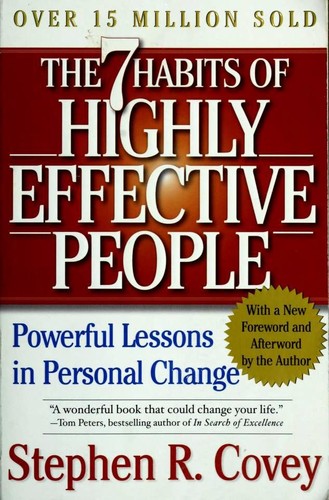
Talk to The 7 Habits of Highly Effective People like its author wrote you back.
Get the ideas that fit your life — not generic summaries.
- Chat with the book
- Audiobook-style main ideas
- Adapts to your life and goals
- Helps you take action
The 7 Habits of Highly Effective People, in detail
Stephen R. Covey's argument is that most self-improvement advice treats symptoms rather than causes. He draws a contrast between the "personality ethic" — the techniques and shortcuts that dominated popular success literature after World War I — and the "character ethic" that dominated prior to it. Covey's claim is that lasting effectiveness has to be built on principles like integrity, humility, and fairness, not on tactics for making people like you. The seven habits are meant to be an integrated system, not a checklist.
The first three habits address what Covey calls the private victory: becoming independent in a mature, principled way. Be proactive means taking responsibility for your own choices rather than attributing your responses to circumstances or other people. Begin with the end in mind means clarifying your values and long-term goals before letting urgent tasks drive your days. Put first things first means scheduling around those priorities rather than reacting to whatever feels pressing. Covey illustrates this last habit with a time-management matrix that separates the important from the merely urgent — the insight being that most people spend their time in urgent but unimportant quadrants and neglect the important but non-urgent work that actually moves life forward.
The next three habits concern the public victory: building productive interdependence with others. Think win/win argues that most negotiations don't have to be zero-sum and that relationships built on mutual benefit are more durable. Seek first to understand, then to be understood is Covey's reframing of communication: most people listen with the intent to reply rather than to genuinely comprehend, and that failure is the source of most interpersonal friction. Synergize holds that genuine collaboration — valuing differences rather than tolerating them — produces outcomes neither party could reach alone. The seventh habit, sharpen the saw, is about renewal: sustaining the physical, mental, social, and spiritual capacity that the other six habits require.
The book's age shows in places. Some of the business examples are dated, and the reliance on Covey's consulting background gives certain sections a workshop-manual feel. The prose is not especially lean. But the underlying framework has held up well: the distinction between urgency and importance, the principle that trustworthy character precedes effective technique, and the idea that you have to orient yourself before you can orient your relationships — these are ideas that have influenced management thinking for decades and continue to appear, repackaged, in newer books on leadership and habit change. Covey is not always the easiest read, but for readers willing to engage with the whole model rather than cherry-pick habits, there is a coherent philosophy here.
The big ideas
- 1.
The personality ethic (techniques and image) cannot substitute for the character ethic (integrity, humility, fairness). Lasting effectiveness is built on principles, not on shortcuts.
- 2.
Be proactive means your responses to events are chosen, not conditioned. Between stimulus and response, there is always a space — and that space is where your freedom lives.
- 3.
Beginning with the end in mind means writing a personal mission statement and letting it govern decisions before urgency does. Most people drift because they never clarify what they actually want.
